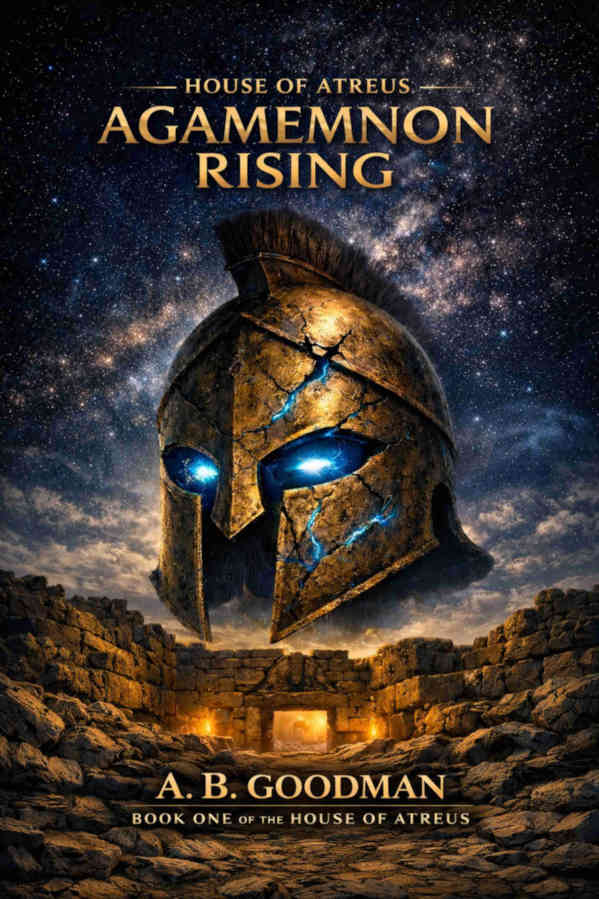
A MYTHOLOGICAL SCI‑FI EPIC ABOUT GODS WHO AREN’T GODS—AND A KING DOOMED BEFORE HE EVER TAKES THE THRONE.
For fans of Circe, The Song of Achilles, and Babel
Book 1 of a completed 7‑book saga
(monthly releases begin June 15, 2026)






Before Westeros, there was Mycenae.
Before dragons, there were gods. Before fantasy, there was history… told not in the way Disney whitewashes it, but in the way it was written – reformatted into a modern thriller pace, capped with a Sci-Fi twist that helps make sense of it all!
A Mythic Sci-Fi Epic!
Before the Trojan War. Before the end of the Bronze Age. Before a father raised a knife above his own daughter…
The House of Atreus was already destroyed from within.
A Bloodline Shaped by Murder, Prophecy, and Revenge
More than three thousand years ago, the royal family of Mycenae was consumed by betrayal and violence. History remembers them as legend. The ancient world called the forces manipulating them “gods.”
But they were not gods.
Apollo. Artemis. The Oracle of Delphi. All were ancient, damaged intelligences—remnants of a lost civilization. They did not answer prayers. They ran programs. They did not grant visions. They manufactured prophecy. They steered human history toward their own ends.
And the House of Atreus was one of their game pieces.
How Does a King Raise a Knife Above The Neck Of His Daughter?
To understand that moment, you must go back to the beginning:
To a boy hiding in the shadows as his father serves a brother the cooked flesh of his own children.
To a false oracle engineered by a malevolent intelligence older than civilization.
To a Spartan princess forced to choose between love and duty—until the choice is stolen from her.
To an exiled prince who swore he would break the cycle of violence… and who won every battle while losing everything that mattered.
The Rise of Agamemnon
From hunted refugee to celebrated warrior to King of Mycenae, Agamemnon’s path is carved by courage, mercy, disastrous love, and the whispering of unseen voices:
“…destiny is on your side…”
Destiny? Perhaps. But the voices were never on his side. They were only on the side of themselves.
The Immortal Witness
Above it all, an ancient observer named Mikael watches the House of Atreus—and his own corrupted siblings—play out a tragedy millennia in the making. Bound by oath to witness and never intervene, he has seen kingdoms fall, children die, and humanity kneel before machines dressed as gods.
He knows what is coming. He knows who is pulling the strings. But he cannot say a word.
Because it is part of him. It is the way he was made.
The End of an Age Begins
The first ships from Troy appear on the horizon. Paris is sailing. Helen is dreaming. Agamemnon sits alone on his ancestral throne, victorious and haunted.
And the chain of events he has set in motion will destroy not only Troy, but the entire pre‑classical Greek world—ending the Bronze Age forever.
This is his story.
A Note From The Author to the Reader
This novel is a fictionalization of real events from the ancient world, viewed through a science fiction lens. The source material comes from the classics. That is, the poetry and tragedy plays of ancient Greece, which recorded the history of the House of Atreus across millennia.
Those plays did not flinch. Aeschylus, Sophocles, and Euripides chose darkness deliberately. Greek tragedy was never meant to flatter its heroes. It was meant to illuminate the human condition through their failures. The themes these playwrights preserved… violence, sexual assault, incest, infanticide, matricide, and vicious cycles of revenge… were not cautionary inventions. They were, in all likelihood, the events as they actually occurred. To soften them would be to lie about them.
I have not lied about them.
I have handled this material with modern care and sensitivity, but I have not sanitized it. What you will encounter in these pages is difficult and, at times, deeply uncomfortable. That discomfort is not gratuitous. It is the point. These stories survived thousands of years precisely because they confront something true and unresolved about human nature. They address our hunger for power, our capacity for cruelty, and our painful, imperfect attempts at justice.
This series is written for adult and young adult readers who are ready to engage with history on its own terms. It asks the questions the ancients asked: What does violence cost across generations? Can cycles of vengeance be broken? And when we make our choices… shaped though they may be by circumstance, by ambition, by forces beyond our control… are we ever truly free?
Those questions have no easy answers. They didn’t then. They don’t now.
Chapter 1: The Sacred Murder
Aulis, Greece – 3,212 years ago
The knife caught the light, reflecting the morning sun. I stood at the edge of the sacred altar at Aulis, invisible to every mortal eye, and watched King Agamemnon.
Forty-three years ago, I had allowed myself to hope this man might be different. I remember how I stood in a Mycenaean courtyard and watched the infant draw his first breath. Over decades, I whispered into his conscience, hoping this descendant of Tantalus might finally see clearly where his ancestors had been blind.
That hope died here, with the girl kneeling at the altar.
The entire Greek army had assembled in a vast semicircle around the ancient altar. Not just kings and commanders, but every soldier, every servant, every camp follower. Thousands of faces turned toward the center in absolute silence.
At the altar, Iphigenia waited. She wore simple white linen that made her look younger than her thirteen years. Dark hair braided with sacred laurel leaves. Her hands were steady at her sides. No tears. No trembling. No desperate backward glances seeking rescue that would not come.
I moved closer to the girl, though she could not see me. Her face held terrible composure, the kind that came from accepting what could not be changed.
The morning air grew unnaturally still. A hawk’s cry died mid-note. The wind itself seemed to hold its breath.
I felt their presence before I saw them. Apollo and Artemis. Their forms wreathed in light that cast no earthly shadows.
“Are you satisfied, sister, that you ordered this innocent 13 year old girl to be slaughtered by her own father?” Apollo asked.
Artemis smiled.
“I will be satisfied when your precious mortal learns his lesson.”
Apollo disappeared without responding.
I thought, for a moment, of doing the same. But this was my burden. To watch. To bear witness. And to remember.
“You must stop this!” I urged, even though I knew Artemis would not acknowledge me. She had not spoken to me in centuries. “This has gone too far. The child is innocent!”
But Artemis did not turn. To her, I no longer existed. She had no intention of listening to anything I had to say.
Twenty paces from the altar, Queen Clytemnestra stood flanked by her women. Her face seemed like carved marble. However, her eyes burned with fury. She had not spoken a word to Agamemnon since he and she had confronted each other, yesterday, about the order from the goddess that the child be slaughtered by her own father. But I could read the message written in her rigid posture as clearly as if she had screamed it across the assembly.
‘You are no longer my husband. You are the murderer of my child!’
That was another tragedy waiting to unfold.
Agamemnon emerged from his tent. Each step toward the altar was slow and painful. I could see that. The silence of the thousands of men under his command pressed against him from all sides. Artemis had commanded this killing, but everyone wondered whether he would really do it.
Generation after generation, the descendants of Tantalus had repeatedly chosen reputation over conscience. And here we were, once again.
Iphigenia turned as her father approached. For a moment, something flickered across Agamemnon’s face. Understanding, perhaps, of the magnitude of the transgression he was about to commit.
“Father…”
Her voice carried clearly across the assembled multitude. Steady. Sweet.
I leaned close and whispered into his mind:
“You can still choose differently. Put down the knife. Walk away. At least you will have your soul.”
But the king did not hear me. Instead, his hand closed around the hilt of the blade. As Agamemnon raised it into the air, Iphigenia’s eyes went distant. Her voice took on a strange quality, as if she spoke from beyond the veil of mortality.
“I see them,” she whispered. “The ones called gods. They are not what they pretend to be.”
My breath caught. Or, at least, it would have, if I breathed the air of this world, which I do not. But she could see us! Normal humans can’t see us, unless we want them to. Yet, somehow, in this moment between life and death, the girl could see what her fellow humans could not.
Above, Artemis’s perfect features twisted with rage.
“She sees too much. Silence her already!”
But I was amazed. This young girl was a mortal who understood. Who saw the truth. And she was about to die. And the understanding she had would die with her.
The blade hovered in the morning sun.
Iphigenia waited. Time itself seemed to stop. And I, who had watched the bloodline of this family stumble toward destruction for so many generations, who had hoped and failed and hoped again, stood witness to the choice about to be made, as her father’s knife hovered above her throat.
I stood witness, invisible and powerless, as Agamemnon’s hand hung suspended in the air. And, finally, I could not watch it anymore. I broke my oath that day by averting my eyes. I could not bear to see that blade fall.
The story I will tell you, the tale of how we came to this moment, of all the choices that led here, and of what came after this, does not begin on this horrible day, or upon this blood-soaked altar. Let me explain it from the beginning.
Chapter 2: Feast of Souls
Mycenae, Greece – Palace of King Atreus – 3,247 years ago
The smell told Agamemnon everything.
I watched him as he crouched behind the lightning-scarred olive tree, eight years old and already understanding that some knowledge can hollow a person out from the inside. His father moved around the brazier fifty yards away, roasting some kind of meat. But the meat was wrong. It wasn’t beef or mutton. It wasn’t chicken or fish. It was something that made Agamemnon’s throat close and his skin prickle.
King Atreus of Mycenae bent over his work with the concentration of a priest preparing sacred offerings. No birds sang, no insects buzzed, there was no wind through the leaves. Something was definitely wrong.
The young boy clung to the ancient bark. A servant had grabbed Agamemnon’s arm just that morning. His eyes were wide as he spoke:
“Don’t go to the grove today,” the man had warned the boy, “Stay away from there!”
Which of course meant an eight-year-old boy had to go. So here he was. He was at the grove. But, he no longer wanted to be where he was. He wanted to run away.
He saw, as I did, when his father raised his face skyward, with tears running down his cheeks.
“Father Zeus!” King Atreus’ voice cracked across the unnatural silence. “Lord of justice! Witness what treachery has driven me to! Thyestes stole my wife, my throne, my sacred ram. He stole everything from me! Now he will feed on the fruit of his theft!”
The words hung in the air with a malevolent life of their own, and the space around King Atreus began to shimmer.
Agamemnon couldn’t understand it. He knew that the shimmering wasn’t from any kind of heat and had to be something else. He saw the air fold in on itself, and become very bright. For him, reality seemed to bend, and the normal flow of time and space probably seemed disrupted.
Ripples of air spread outward in perfect circles, and when they touched the olive trees, the leaves rustled, though there was no wind. The grove filled with a rumble that did not transmit through the air, but was felt inside human bone and blood.
Agamemnon pressed against the trunk of the tree he hid behind, watching the shimmer intensify. Atreus continued carving the meat, seemingly oblivious to the change happening nearby. He was precise and methodical. He arranged the portions, in ceremonial bowls, with priestly care. And, suddenly, Agamemnon realized what his father was cooking.
He remembered all the search parties that had been sent out, only to return empty-handed. His cousins had disappeared.
“No. Father, no!!!” He screamed silently, inside himself.
Then he saw me. I must have seemed to him like a figure wreathed in light, that had materialized from nothing. I approached silently from among the trees, robed in a fabric that was woven from light itself. Agamemnon glimpsed my face but it hurt to look at me for too long.
“King of sorrows,” I said to his father, King Atreus, “This path leads nowhere good. It ends beyond what you can understand.”
Atreus looked up at me and strangely, he showed no surprise at my appearance. It was true that I had come many times, in his dreams, subtly trying to influence him against his baser instincts. But, he had never seen me in person before. Yet he seemed to be expecting me and already knew exactly who I was.
“You speak of understanding, bright one?” His voice was raw. “What of justice? He stole everything from me. He bedded my wife. Mocked me. Imprisoned me. And you speak of righteousness?”
I stepped closer.
“What you do here will echo through generations,” I told him, “This transgression cannot be undone. You have already sinned grievously by murdering these innocent children. Now, by what you are about to do, you will open doors that have always been closed.”
“Ha! It’s already done.” Atreus raised his carving knife like a weapon. “And I don’t care. Let the world burn!”
I closed my eyes and shook my head in disappointment.
“You don’t understand what you do, Atreus. I cannot prevent what comes next. I can only warn you. Evil is endlessly hungry. Nothing will satisfy it.”
“Enough of your nonsense!” Atreus’ shout sent birds scattering from distant trees. “I know all about you. He warned me against you. You are the one who weakened me. Allowed him to depose me. Helped him steal my wife. He has told me that you have no power to stop me. So leave me alone. Go away! I have work to do before my brother arrives.”
It was clear to me, at that point, how he seemed to recognize me. He was being influenced by the Deceiver. The Deceiver had twisted his soul. But there was nothing I could do about that. I fixed on Atreus, for a moment, with a look of grief. Then I turned directly toward Agamemnon’s hiding place. The boy’s breath caught when I spoke directly to him..
“And you, little prince?“
The words weren’t made of sound or carried through the air. They were inside him. And, in contrast with the words I had spoken to his father, King Atreus, these were private words that no one else could hear.
“What will you choose? Will you feed on the same evil that possesses your father, or will you find the strength to do otherwise?”
Agamemnon tried to answer. But he couldn’t. I raised my hand in farewell and spoke, one more time, to the boy’s father.
“You sadden me, Atreus.” I said, in a voice that I knew would reach Agamemnon’s ears, “I would stop you if I could. But it is not permitted. You must choose freely. That is the law. Even if it condemns your soul for all eternity and destroys your progeny, which I assure you, it will.”
Atreus had already turned back to his work, dismissing me with a grunt.
My form faded away into the air and, a few moments later, I was gone. Then, reality slammed back down upon Agamemnon. Air rushed into the boy’s lungs with painful force, as he realized he had been holding his breath.
King Atreus’ hands began to tremble. That tremor hadn’t been there prior to the hoofbeats that thundered through the grove. Many horses were coming closer quickly. They were moving fast.
“Brother!” Uncle Thyestes’ voice rang out as riders burst into the clearing. “This gesture honors our father’s memory. I had not dared hope for mercy.”
Atreus rose, wiping his hands on his robe. The smile that crossed his father’s face made Agamemnon’s stomach turn.
“Come, brother. Come feast. I’ve prepared something special. The finest meat, seasoned with all the love I bear for you.”
It was poison threaded through words.
The men dismounted, arranging themselves around the makeshift table. All smiling. All pleased with this display of brotherhood restored. None seemed to notice how strangely the fire burned, how shadows moved wrong, how the grove itself seemed to hold its breath. Perhaps those were things that only young Agamemnon could sense.
“You’re generous in victory, brother.” Thyestes embraced Atreus. “Let us put the past behind us.”
“Yes,” Atreus whispered. “Let us share everything, as brothers should.”
The men began to eat.
Agamemnon wanted to look away, to run, but he was held in place by the horrible fascination of witnessing something that violated every law holding civilization together.
He watched his uncle take the first bite.
He saw confusion flicker across Thyestes’ face as his palate registered something wrong. But hunger and the desire for reconciliation overcame his doubt. Thyestes continued eating, praising the flavor, calling for wine. The other men followed. Soon the grove rang with laughter and talk of restored brotherhood.
Until the wrongness somehow made its way past the veneer and manifested. Thyestes set down his bowl. His hands were shaking.
“Brother.” His voice was slow, careful. “What is this? What riddle do you pose?”
“No riddle.” Atreus rose to his feet. Shadows seemed to writhe around him like living things. “Only the truth. Your own blood, brother. Your own children. Sprung from my wife. The woman you stole from me. Payment for what you took.”
From behind his back, Atreus produced a covered platter and, with theatrical precision, he lifted the cloth. Three young boys’ heads stared up. For a moment, the silence was absolute. Then Thyestes began to retch. His body fought to purge what he had consumed. The other men followed suit, their retching creating a chorus of revulsion that seemed to crack something in the air itself.
“What have you done?” Thyestes gasped, falling to his knees. “What have you made me do?”
“I have fed the darkness that dwells in the heart of all things.” Atreus’ laugh was hollow. “And the darkness will feast on our children’s children until the stars grow cold. Just as you feast on your own children now!”
A sound like shattering crystal rang through the grove. Thyestes rose, and his hand moved to his sword. His men followed, blades scraping from sheaths. But Atreus stood perfectly still, continuing to smile. There was no triumph in that smile. Just satisfaction.
“Yes, brother. Draw your sword. Try to slay me. You’ve always wanted to.”
Thyestes’ blade was half-drawn when the soldiers appeared. Row upon row of Mycenae’s finest, their bronze armor glinting in the sunlight. Bows drawn. Aimed at the hearts of Thyestes and each of his men. They’d been waiting for this moment. Hidden.
Thyestes’ hand froze, and he looked at his men, saw their drawn blades, but also their faces. They all understood. They were trapped. Hopelessly outnumbered, twenty to one, with arrows tipped in the sharpest bronze aimed directly at their hearts. Thyestes would not be able to cover more than two steps toward his brother before catching an arrow to his neck.
“Your men fought well on the road,” Atreus offered, almost gentle now. “They died protecting you. Foolish men. But they were loyal to you.”
Thyestes’ sword clattered to earth. His arm fell as if the limb no longer belonged to him.
“How long?” Barely audible. “How long have you planned this?”
“Since the day you took my wife. Since she birthed these abominations. From the moment you thought yourself clever enough to betray the House of Atreus. I have been patient, brother. Patient and thorough.”
Thyestes’ men lowered their weapons. Some stood frozen, understanding that resistance meant instant death. Their leader was already condemned. They would also be, if they lifted their swords against King Atreus.
Thyestes simply stood there, staring at his brother.
“The children,” he whispered. “Where are the others?”
Atreus’ smile widened. He didn’t answer. He didn’t need to. Thyestes fell to his knees again. This time not retching, but producing a sound from somewhere deeper than the body could reach. Something broke inside him, shattering in so many directions that it could never be reassembled.
Then, there was a complete suffocating silence. Agamemnon watched the horror bloom in his uncle’s eyes. He was a man unmade by the realization of his utter and absolute defeat. His children, his legacy, his entire world. All gone.
The soldiers disarmed Thyestes and his men and led them away. They didn’t resist. If they had, the effort would have been useless. They would have been instantly slaughtered. They moved where they were pushed, their eyes becoming unfocused.
Agamemnon remained behind the olive tree, his entire body shaking. I had asked him if he would choose differently. And, even though he was only eight years old, his small fists now clenched together as he remembered my question.
“I will choose differently,” he whispered, “When my moment comes, I swear I will.”
But the future stretched ahead, unknowable. He turned from the grove, leaving the shadows behind. He did not know when his moment would come. It was far in the future. Nor did he know that, when that moment did come, it would be draped in the language of duty and the mask of “necessity.”.
Chapter 3: Maculate Conception
On the Path From Sicyon to Delphi – 3212 B.C.
The mountain path twisted upward through the pine forests. Ever upward. Thyestes moved silently. Behind him, the coast of Sicyon receded. Ahead lay stone and sky and the possibility of the answers he wanted.
He’d endured three weeks of his brother’s prison after unknowingly consuming his own children. Then, he’d managed to escape with the help of some people still loyal to him. Weeks of wandering and misery after that. He’d found food and shelter in caves where shepherds left offerings to gods who never listened. They didn’t need the food. He did.
The Oracle at Delphi was still a three day journey up the mountain. It would take him longer than that because he moved so slowly. But he was resolved on the idea of finishing the pilgrimage. He needed answers. The Pythia, Apollo’s Oracle, could tell him what to do. If he only followed her prophecy, all would be well.
The temple at Delphi sat upon a mountainside. All the polished stone columns caught the afternoon light on clear days and reflected it back in deliberate, calculated ways. Designed to manipulate, the place was magnificent in its own special way. Priestesses moved smoothly through the courtyards with fluid grace. Their eyes held inhuman depths.
One of them approached as Thyestes emerged from the forest path. He was dirt-stained and hollow-eyed.
“The oracle receives few supplicants in winter,” she said.
“I must see her,” Thyestes replied.
His voice sounded strange even to him. Almost as if it belonged to someone else. Someone further away than mere distance could explain.
The priestess studied him.
“You carry the scent of death,” she asserted. “Not your own death. That would be a mercy, I think. But of the deaths of others. I see them clinging to your spirit.”
“My children,” Thyestes said in a whisper. “I ate them. Does the Pythia need that explanation, or does she already know?”
Something flickered across the priestess’ expression. Not surprise or judgment. Something more complicated. She nodded once and gestured toward the temple’s interior.
“Come. The oracle has been expecting you for some time now. She said you would come, though she did not know your face. Only your desperation.”
Together, they descended into the oracle’s chamber. It felt like they were entering into the earth’s mouth. Stone walls made by human hands gave way to hard rock of natural cavern walls.
This part of the shrine was where the air grew thick and sweet, carrying the scent of sacred vapors. Those vapors drove prophetic ecstasy. The Pythia sat upon her tripod in the chamber’s heart. Her body was moving with rhythmic precision. It was the type of thing that made people believe she existed partially outside ordinary time and space. Her eyes were rolled back into her head, showing only whites, yet somehow she seemed aware of everything around her.
“You wish to know if you are cursed?” she said, her voice layered as if multiple women spoke through the same throat. “You wish to discover if the gods have abandoned you or if you have abandoned them. You want to find redemption. Am I right?”
“Can the Oracle answer such questions?” Thyestes asked, although he was already sure that she could.
“The Oracle answers only those questions that the gods want answered. But today, son of Pelops, the gods are interested in you.”
The Pythia’s body convulsed, and for a moment her eyes snapped forward, and her pupils were suddenly visible again. They locked onto Thyestes with an intensity that made him step backward.
“The debt for Atreus’ crimes will not be paid by Atreus alone. Not only in this generation. Not only in the blood that flows directly from his veins. But also in the blood of future generations.”
“What does that mean?” Thyestes whispered.
“It means that the weapon that defeats your brother cannot come from a normal succession. The weapon must be corrupted from its source. It must be born of a violation so severe that even its victim becomes part of the mechanism.”
“I don’t understand. You speak in riddles.”
“Truth is always a riddle, when comfortable lies are preferred,” the Pythia’s body went rigid, her voice dropping. “But the Oracle speaks plainly. Your brother can only be defeated by a child born of your pure blood. That child can only exist if you embrace depravity.”
Thyestes felt the world tilt at an angle that had nothing to do with the vapors rising from the earth.
“I will not embrace depravity.”
“Then your brother, Atreus, will win. Completely. Absolutely. And finally. He will have no obstacle
Someday he will kill everything you love. Every generation will know his shadow. His sons will follow in his footsteps. None will have the strength to break free.”
At that, the Pythia stopped speaking for a moment. Her eyes opened fully. It seemed like an entire universe swirled inside them. They were hypnotic. Then she continued.
“But if you embrace depravity, now, and corrupt yourself completely, so that even the gods must look away, your line will produce a weapon that will, in the end, destroy the depravity and evil that is Atreus.”
“What weapon? You speak in metaphors that mock me,” Thyestes objected.
The Pythia ignored his protest and continued further.
“Return to the land of your exile. Seek out the one of your blood who still survives. Pelopia, your daughter, who was raised in Sicyon by her mother, and knows not your face. But you know hers. She is the womb through which redemption will be issued forth.”
“I can’t do that. She’s my daughter.”
“That is precisely why you must. The violation must be complete. All must be corrupted before corruption can be extinguished. All that is sacred must be desecrated.”
Then the Pythia’s voice grew stone cold.
“Otherwise, Atreus will continue his reign. His children will follow after him. And those children, knowing no other way, will follow in their father’s footsteps. They will rule the same way he did. Only the issue of Pelopia’s womb can destroy him.”
“But you don’t understand,” Thyestes objected again.
The Pythia did not respond.
“You may go now.”
The lesser priestess who had led him to the Pythia now led Thyestes back out into the temple courtyard. Twilight painted the sky. But the colors seemed wrong. They were too vivid. Too strong.
“It’s impossible,” Thyestes mumbled to himself, but loud enough for the lesser priestess to hear him, and she replied.
“When the Oracle delivers a prophecy, it carries the signature of the gods. What did she tell you?”
Thyestes couldn’t say the words. Speaking those words would make them feel too real. Somehow, he felt like his silence would keep reality at bay. He turned and ignored her question. He simply headed back down the path toward Sicyon, his mind churning with conflict.
On the six-day journey home, he moved even slower than he had on the way up. He was in no rush. The Pythia’s advice haunted him. It was impossible to accept that Apollo’s oracle could counsel such a thing. Yet she had. Given how horrifying the prophecy actually was, and how deeply it violated the laws and customs of Greece and of the Greek gods, it had to be the only path to salvation. The only path by which he could end the suffering his brother inflicted on everything he touched. Or so he thought.
Following her advice meant becoming a pariah. He would be committing an act that would condemn him forever. He would be scorned in the world of men and gods. His daughter, he knew, would never consent willingly. He would have to force her. There was no other choice. Of course, on the other hand, she didn’t know his face. But her mother did. As he walked, he tried to stretch out each day for as long as possible. His futile hope was that the journey could last long enough for him to discover another way.
When he finally arrived, he secured a room at the inn in the center of Sicyon. It was a modest establishment that catered to merchants passing between the northern cities and the coastal trade routes. The room was small, with a single window that overlooked a busy commercial street where merchants hawked their wares and children played in dust that never quite settled. The kind of place where a broken man could find peace by becoming a nobody.
Inside the cramped room, Thyestes removed his tunic and faced the narrow mirror. Two months had passed since his brother had served him the cooked flesh of his own sons. Spiced flesh that he had unknowingly eaten and enjoyed. Until, of course, he had found out where the meat was from.
In the intervening period, he had aged visibly. Far beyond what time alone could explain. The weeks of wandering and anguish had hollowed him out. He had eaten little and traveled much. His shoulders curved inward. His belly hung loose and wrinkled, like dried fruit. He was a wreck of a man.
Sleep didn’t come easily. When it arrived, near dawn, it brought dreams of the faces of his sons, twisted into shapes that did not quite belong to them anymore. Faces blending onto the bodies of lambs and then he saw the faces of girls whose identities he didn’t know. Finally, he awakened into the real world, dressed, and left to find Pelopia, his daughter.
He found her at the river in the failing light. She didn’t know his face. Pelopia had never seen him. She fought. Her strength surprised him, born of youth and the sudden understanding that danger had arrived from an unexpected direction. In the struggle, her hand found his sword. She fled, with his sword still in her hand, leaving him in the river behind her. It was cold. The sound of her crying would haunt him until his death.
Thyestes remained in the river, letting the water flow past him. But water was not enough. Nothing could ever wash away that sin. For he had crossed into the land of evil, just like his brother, Atreus. And once inside, there was no way out again.
The pregnancy revealed itself over several weeks, a biological insistence that eventually made denial impossible. Pelopia bore the child in silence, continuing the tasks that were part of her daily life, as if nothing had happened. It was the careful efficiency of a woman who had decided that speaking her pain aloud would only cause her yet more pain.
The child was a boy. He would eventually have dark hair just like both his parents. Pelopia held him only briefly. Then she tried to forget her shame.
I watched, hidden from sight, as Pelopia handed the infant to the shepherd, her hands trembling. That was the moment I first sensed it. Not the presence of an Olympian, those so-called divine siblings of mine, nor that of a mortal. It was something else. Another sibling. My older brother. The Deceiver.
A being I wish I could erase from existence. Over countless millennia, he had learned to seep fragments of his essence through the prison walls the Creators had forged to contain him. And with each escape, he ensured no one would ever forget him. Even now, his voice slithered through the quantum barriers of his confinement, reaching out to remind us all.
“You see it, don’t you?” His voice came from nowhere and everywhere at once, a contamination that spread through the fabric of reality itself. “The beautiful machinery of it all?”
I did not reply because I knew who it was.
“The prophecy I gave him was true, you know,” the voice continued.
I could hear satisfaction in his voice.
“It is so clear to me. I can already see Aegisthus destroying Atreus. But not the way the foolish human expects. Not the way he hoped. I see him ruling through fear and corruption just like Atreus.” The voice seemed to chuckle with delight, “He will become exactly what he was designed to defeat. It is poetic, don’t you think? All this, because one desperate man did whatever the Pythia told him to do? Ha!”
“You lied to him.” I finally said, unable to restrain myself further..
The voice paused. For a moment, the presence seemed almost to recede, as if wounded by the simplicity of my statement.
“No!” Yoblish finally replied, and now the voice was colder, more dangerous, “I simply told him the truth. But truth corrupts far more effectively than lies ever can. I showed him the path and let him walk it. But it’s his choice. Every step of the way…”
“The prophecy came through a false Oracle,” I said. “Apollo did not speak.”
“No,” Yoblish agreed, his laugh echoing, “But, then, Apollo is such a young fool. He wouldn’t know what to tell him anyway. It was simple enough to enter what Apollo calls “his” Oracle and make her speak with MY words. But here is what you fail to understand, brother. I told Thyestes what he wanted to hear. I gave him permission to do what he already desired. That’s the genius of it! I do not force. I merely unveil what is already in their hearts. I don’t create anything new. All I need to do is remove the obstacles to fulfilling the desires they keep caged.”
I felt the twisted truth of what he had just said, and its weight was crushing me.
“The boy deserves better than this,” I said quietly.
“The boy deserves exactly what he will get,” Yoblish replied. “As do all humans. Every creature born into this world is born compromised. I don’t make them that way. I only reveal what they already are. And, here, I accelerated what time and mortality would eventually accomplish without me. You should thank me for my efficiency. I do the gods’ work far better than they do!”
The presence began to withdraw, sliding back behind the quantum walls of its containment. But before it fully receded, Yoblish’s voice returned one final time. He could not stop gloating.
“You know, Mikael, our siblings have already seen the wisdom of my way. Every Olympian dances to my tune. They think that they rule, but they are already my puppets. How long do you think you can remain pure? How long before you, too, begin to see the logic of my way?”
Then he was gone, leaving only silence.
The boy would grow up not knowing his true mother or father. Not knowing that a crime had created him. Without knowing that his existence was a prophecy made into flesh. A weapon forged in violation of all the laws of men and gods.
He grew up as a shepherd’s foundling, raised among simple folk. People with little money but a lot of love. He was given the name Aegisthus. As time progressed, he would grow strong and hard. But he would never know that ambition and revenge were already written into his DNA at the time of his birth.
And, so, I continued to stand vigil over the contamination that was spreading through the descendants of Tantalus, knowing I could not stop it. Knowing that I could only watch as the machinery of destruction ground forward, as one man poisoned yet another.
I had failed to prevent Atreus’ feast. I had failed to reach Thyestes before the Oracle’s words took root. And I would fail again and again, watching from the margins as the corrupted bloodline spiraled toward its inevitable ruin.
This was my burden. To witness. To remember. And to carry the weight of choices I cannot prevent if staying loyal to my prime directive.
Chapter 4: The Cost of Silence
Mycenae, Ancient Greece – Palace of King Atreus – 3,230 years ago
Clytemnestra, princess of Sparta and priestess of Hera, stood in the courtyard of Mycenae’s Temple of Hera, watching smoke spiral upward from braziers positioned at precise intervals around the sacred space. The incense hung so thick in the air it stung her eyes.
Around her, the Mycenaean priestesses moved through their duties. But something was wrong. The younger priestess to her left held her shoulders too rigidly. The older woman near the altar kept glancing toward the palace gates.
“The offerings are prepared, my lady,” said Eurydice.
She was the eldest priestess. Perhaps fifty years old, dark hair streaked with gray, eyes lined with wrinkles that came from watching too many things she could not change. “Will you inspect them before we begin?”
Clytemnestra followed her to the altar. Fresh barley cakes, honey, a young lamb without blemish. Everything according to custom. Yet Eurydice’s hand trembled as she gestured toward the arrangements.
“Something troubles you?” Clytemnestra asked quietly.
Eurydice’s eyes darted toward the palace, then back.
“No, my lady. All is as it should be.” Eurydice’s hand trembled.
Clytemnestra had arrived only three days ago as part of her father’s diplomatic mission. King Tyndareus valued his alliance with Mycenae despite Atreus’ reputation for brutality. When you commanded the largest army in Greece and controlled key trade routes, reputation mattered less than utility.
I am here to smooth relations between Sparta and Mycenae. To show that Hera blesses this union. Not to make waves.
A young servant rushed into the courtyard and made direct for one of the priests near the eastern colonnade. Urgent whispers. Clytemnestra caught only fragments.
“The king’s men.”
“Another execution.”
Her stomach tightened. The fourth since her arrival.
The priest’s face went pale. He hurried to Eurydice and repeated the news. The older woman’s composure cracked for just a moment, revealing something that might have been grief or rage or simply exhaustion. Then the mask returned.
Before Clytemnestra could speak, a palace guard appeared at the courtyard entrance. Young, perhaps twenty, with the hard eyes of someone who had learned not to question orders.
“Princess Clytemnestra of Sparta,” he announced formally. “King Atreus requests your presence in the palace megaron for a celebration of Mycenae’s strength. Your attendance would honor us.”
The phrasing was courteous. The underlying command was clear.
“Of course,” Clytemnestra said, keeping her voice steady. “I would be honored to attend.”
King Atreus’ courtyard had been transformed into a theater. Banners bearing the golden lion of Mycenae hung from every column. Long tables were heavy with food and wine. Musicians played near the eastern wall, their cheerful melodies obscene given what Clytemnestra suspected was coming.
King Atreus held court in the megaron, the great hall at the heart of his palace. His throne stood against the right-hand wall, with his back against the solid stone of the citadel. This ensured that no man could approach unseen.
The circular hearth at the hall’s center blazed with flames. Its light caught the frescoes on the walls: depicting bulls, processions, and the hunt. Smoke hung thick in the air, mixing with the smell of roasting meat.
Atreus reclined on cushions of dyed wool, his body angled toward the room like a man who never truly rested. Attendants moved quietly between him and his low table, setting down cuts of meat, barley cakes, dark wine mixed with water. Fifty years old, powerfully built despite the iron-gray hair, he wore his age the way the citadel walls wore theirs. Proof he had survived many enemies.
To his right sat his two sons, Agamemnon and Menelaus, sharing a table. Beyond them, the megaron opened into the courtyard where nobility and warriors gathered in careful hierarchy. The tables were arranged according to rank. The highest-ranking nobles were positioned closest to the king. Common soldiers stood in the outer court.
Every placement, every cup distributed, every portion allocated was a statement of power. The king sat at the apex of it all, and everyone faced him, always lower, always aware of the stone wall at his back.
As a virgin priestess of Hera, modesty required Clytemnestra to wear a semi-translucent veil. But she studied everything she saw with analytical precision. Menelaus was a few years younger than his brother, Agamemnon, with an open face that still held traces of boyhood. He stood slightly behind his brother.
It was Agamemnon who attracted and held a majority of her attention. He looked about twenty-four or twenty-five, which was consistent with the information about him that she’d been briefed on, before leaving Sparta. He was tall and lean, handsome, with a regal bearing. He had the look of a well-trained warrior.
A guard escorted her to a position near the platform. Close enough to show honor. Far enough away to maintain her status as observer rather than participant.
“Princess Clytemnestra,” King Atreus called out, his voice carrying easily across the megaron. “Thank you for joining us. Sparta’s presence graces our celebration.”
“The honor is mine, great king,” she replied, executing a formal bow that satisfied protocol without suggesting subservience.
Atreus smiled. He gestured to a servant, who brought forward a chair positioned to give her an unobstructed view, positioned among the highest nobility, at his right side. She sat and a personal table was brought for her.
‘He wants me to see his power and carry word to my father…’ She thought to herself.
Then, the musicians fell silent. Conversation died. Every person in the courtyard turned their attention toward the king.
“Now, we shall witness justice done,” Atreus announced. “We will demonstrate how Mycenae deals with those who would undermine the foundations of our city-state, and the stability we have built.”
Guards emerged from the palace, dragging seven men in chains. Nobles, she could see, from their bearing, and the remnants of fine clothing. But they had been beaten. Blood marked their faces. Their hands were bound behind their backs.
“These men,” Atreus continued, “have been found guilty of opposing the royal tax assessments. Stirring up dissent. They have spread their poison among the merchant class. They have questioned my authority and encouraged others to do the same.”
One of the prisoners, an older man, lifted his head.
“We asked only for fairness, my lord. The taxes have tripled in two years. Our people starve…”
Atreus’ expression didn’t change.
“Did I give you leave to speak?” Atreus asked.
“No, my lord, but…”
“Silence him.”
A guard struck the man across the mouth with casual efficiency. The old nobleman fell to his knees, blood streaming from split lips.
Clytemnestra’s hands clenched in her lap. Every instinct screamed at her to intervene. This is not how her father ruled. This was unjust. But she was a guest in a foreign court, representing her father’s interests. One wrong word could shatter the alliance Sparta desperately needed.
“The sentence for undermining the king’s authority is clear,” Atreus said. “Each of these men will have his left hand struck off. A permanent reminder of the cost of treason.”
The courtyard erupted in murmurs. Even among those accustomed to Atreus’ brutality, it seemed excessive. These were not common criminals. Their families were well thought of. Now she understood the faces of the Mycenaean priestesses of Hera. All of the priestesses, generally speaking, came from the noble families, and they were, no doubt, aware that Atreus was about to cut the hands off their relatives, friends or associates.
But Atreus seemed unconcerned by the murmurs and the discontent it might signal. He gestured toward the executioner. A massive man stepped forward carrying an axe.
The first prisoner was forced to his knees. His hand was placed on a wooden block. Clytemnestra forced herself to watch, even as her stomach churned. She would not let anyone see a princess of Sparta become squeamish, no matter what the atrocity.
When the executioner raised his axe, Agamemnon moved.
Clytemnestra saw the tension in him. Almost as if he were bracing for a blow, himself.
He stepped forward, leaning close to his father. The movement was smooth, practiced. His voice was too low for Clytemnestra to hear, but she watched Atreus’ face shift from certainty to irritation to calculation.
Agamemnon’s expression remained neutral, but his shoulders carried tension. The posture of someone balanced between obedience and defiance. One wrong word and he would incur his father’s wrath. But he held his ground, and for thirty seconds that felt like an eternity, father and son existed in silent negotiation.
Finally, Atreus raised his hand. The executioner lowered his axe.
“My son reminds me that the House of Atreus can also show mercy,” Atreus said, though his tone suggested he found this concept distasteful. “Therefore, I will offer these men an alternative. A fine of one hundred gold talents each. To be paid within one month.”
The amount was staggering. Enough to bankrupt all but the wealthiest noble families. But it was better than mutilation.
“However,” Atreus continued, his voice hardening, “if any of you are discovered engaging in similar activities in the future, there will be no further mercy granted. Your hand will be taken, and possibly your head as well. No pleas will be heard. Do you understand?”
The prisoners nodded frantically, relief and terror warring on their faces.
“Take them away,” Atreus commanded. “They have one month to pay the fine. If they do not, the executioner will finish what we started today.”
As the guards dragged the prisoners back toward the palace, Clytemnestra found her eyes drawn to Agamemnon. He stood motionless beside his father’s throne, his expression revealing nothing. But he had risked his father’s displeasure to prevent seven mutilations.
The festivities resumed with forced gaiety. Wine flowed. The musicians played. Nobles laughed too loudly and drank too quickly, trying to wash away the memory of what they had almost witnessed.
Clytemnestra picked at her food, maintaining the appearance of participation while her mind worked through all the implications. Her father needed to know about this. Not just Atreus’ brutality, but of the fear that permeated every level of Mycenaean society.
But what could her father do with that information? Break the alliance, leaving Sparta vulnerable to northern aggression? He wouldn’t. She was sure of that. There was no good option.
The summons to Atreus’ private chambers came that evening.
She had expected it. The “celebration” was the performance. Now came the private conversation where the real message would be delivered.
She was escorted through corridors lined with tapestries depicting Mycenae’s victories. Past rooms where servants moved quietly, eyes downcast. Guards stood at every corner. The palace felt to her like a fortress of unhappiness.
Atreus’ private study was surprisingly simple. Maps covered the walls, showing trade routes and territorial boundaries. A desk held scrolls and correspondence. The only luxury was a wine service of exceptional quality, cups carved from alabaster and inlaid with gold.
The king stood by the window, looking out over his domain. He didn’t turn when she entered.
“Tell me, Princess,” he said, “what does Sparta think of today’s events?”
Clytemnestra chose her words carefully.
“Sparta appreciates strength, my lord. We understand the challenges of maintaining order.”
“A diplomatic answer.” Atreus turned to face her. His expression mimicked paternal warmth, but his eyes remained cold. “But I asked what you think, not what your father’s diplomats would say.”
She met his gaze steadily.
“I think justice and terror are not the same thing, though they may sometimes appear similar from a distance.”
“Interesting.” He poured two cups of wine, offering one to her. She accepted it but did not drink. “You sound like my son, Agamemnon. He has similar ideas.”
He moved to the desk, gesturing for her to sit. She remained standing.
“Let me share the truth with you, Princess,” He sipped his wine. “Loyalty is a luxury. Fear is what keeps a king on his throne when all else fails.”
“My father rules through respect, not fear.”
“Does he?” Atreus’ smile sharpened. “Or does he rule through Sparta’s military reputation, which is itself built on fear of what Spartan warriors can do? Your father understands that power requires a foundation. Mine is simply more honest about its nature.”
The argument carried some truth. Sparta’s strength did rest partly on other kingdoms’ fear of its warriors. But there was a difference between respect earned through martial prowess and compliance extracted through brutality.
“Your father allied with me,” Atreus continued, “because he needs Mycenae’s wealth and numbers. The alliance stands because he is a practical man. So am I.”
Much as she would have liked to deny it, he spoke the truth.
‘My father knows what Atreus is. But he believes the alliance is necessary.’
“I see understanding in your eyes,” Atreus said. “You’re intelligent, Princess. Too intelligent to hide behind comforting illusions. The world is built on hard choices. Your father makes them. I make them. Someday, if the gods will it, my son will face similar choices.”
He set down his wine cup with deliberate care.
“When you return to Sparta, tell your father that Mycenae remains strong, that our alliance serves both kingdoms’ interests. Most importantly, tell him that I am the devil he knows. And in these uncertain times, that may be the most valuable thing I can offer.”
It was a dismissal wrapped in courtesy. Clytemnestra bowed with precise formality and turned toward the door.
“One more thing, Princess.”
She paused.
“My son interceded today. Convinced me to show mercy.” Atreus’ voice carried a note of almost academic curiosity. “What did you think of that?”
Clytemnestra considered her answer carefully.
“Your son showed courage.”
“Or weakness. Sentimentality that may undermine him when he rules.”
That night, Clytemnestra stood on the balcony of her chambers, looking out over Mycenae.
The city sprawled below, its walls and buildings illuminated by torchlight and moonlight in equal measure. From this height, it was beautiful. The palace complex rose like a crown atop the hill. The lower city spread outward in concentric rings. Trade routes stretched toward distant horizons, carrying wealth from every corner of the world to and from Mycenae. It was both beautiful and powerful. But, it was also a hollow place.
She thought of the seven noblemen who would spend the next month desperately trying to raise an impossible sum of money. Of the priestesses whose hands were shaking during sacred rituals. Of Agamemnon’s eyes and his quiet intercession that had saved seven hands.
What could she do? She was a princess masquerading as a priestess. She had no army, no power, no real voice. Her mission was given to her by her father, King Tyndarius of Sparta. She was to observe and advise. Pretend to perform the rituals of Hera. Bless the alliance. But for reasons of political necessity. The mindset of these two cities, though both Greek, was as different as night and day.
A sound in the courtyard below caused her to look. A solitary figure was walking in the shadows. But even from this distance, she knew who it was. Prince Agamemnon seemed different than his father, King Atreus. More humane and decent. It didn’t hurt that his height, obvious strength and the way he held himself made him interesting to every young woman. She secretly watched him until he disappeared into the palace’s labyrinthine corridors.
Then, Clytemnestra turned from the balcony and moved to the small altar in her chamber. As a priestess of Hera, she maintained all the proper appearances. She lit the incense, poured a libation, and knelt before the goddess’s image. But the prayer that formed in her mind was not a traditional one.
She thought of Atreus’ words about choosing allies. About her father’s pragmatic acceptance of an alliance with Mycenae. Atreus was obviously a monster. What would happen if she sent word of this to her father? Would he dismiss it simply as the cost of politics? Probably.
As she mulled the idea of complaining to her father she poured the libation. The wine pooled on the stone, and she whispered:
‘Hear my prayer, Hēra Basíleia, oh great and powerful Queen of the gods! When the gods next demand blood, let it be the blood of this tyrant and not of a decent man…’
The incense smoke rose straight and pure, carrying her unspoken oath toward whatever powers might be listening. Probably none, she decided. The gods were probably just imagination and nothing more. Meanwhile, outside her chamber, Mycenae slept quietly. The largest city-state of Greece. It was a beautiful city, but it was run by a tyrant.
She moved over to the desk in the corner of her room and began to write a message. She wrote about King Atreus’ brutality, and his son’s intercession. When she was finished, she rolled the scroll and slipped it into a carrying canister, sealing it with her personal version of the royal seal of Sparta.
Chapter 5: Mercenary Soldier
Aegisthus had spent his life watching sheep graze, give birth, and die. Sometimes, they died to provide food for his family. Other times, simply from accident or disease. It didn’t matter. It wasn’t the life for him.
At thirteen, he was already stronger than some men twice his age. He was quick-witted, restless and hungry. But that hunger wasn’t for food. It was for meaning and purpose. Neither existed in the grass covered Greek hills. He felt like he was wasting his life away.
By law and custom of the ancient world, at the age of thirteen, he was already a man. The right to choose his future was his own. And that future did not include becoming a shepherd in the hills. Beyond the hills, there was an entire world. It lay waiting. He longed to participate in it. He had promised himself that this pastoral existence would soon be over, and the desire to leave was burning in his chest.
That desire was, in truth, a fire that had been lit long before he was even born. It was lit by destiny. He needed to be somewhere else, and knew it as a matter of instinct. For the moment, however, he was trapped. His father had died several years before, weighed down by hard labor in the pasture. Finally felled by disease. His mother was old and weak. Almost too old, it almost seemed, to have borne him. Yet, somehow, she must have.
Mama had been sick all winter. Now, she was pale, thin and frail. Her breathing tended to be slow and labored. She could barely rise from her bed. His grandfather still lived, but the old man was also frail, and couldn’t take care of his daughter-in-law alone. Aegisthus had no choice. He had to stay.
One morning, his mother called him to her side as she lay on her bed. He came, carrying a cup of water, but she waved it aside. She touched him with one trembling hand.,There was something in her eyes he had never seen before. Gravity. Confession.
“Sit,” she said.
He sat.
“You have been a good son,” she began, “But I don’t deserve that. You were never really mine.”
“Mamma,” Aegisthus replied, “What are you talking about?”
“You were not my child at birth. You came to me when you were only a few days old. A young woman, robed in temple white, brought you to our door. She asked us to raise you. Her only condition was that we tell no one that you are her child. Not even you. I had no son of my own…no child at all…so I agreed. And, your father, agreed out of love for me. I did what the priestess asked.
I raised you as my own son. I loved you. Truly, I did love you. I still love you as much as I would love a child of my own womb. But, I am dying, and you must know the truth. About your true mother. The priestess of the Temple of Hera in Sicyon. She is named Pelopia “
Aegisthus felt the breath leave his body. He did not speak.
“I’m sorry I lied,’ she whispered.
Then she coughed. A violent, wet sound. She gripped his wrist with surprising strength.
“Find her. Let her know that you live…” She urged.
She relaxed her grip and lay back down on the bed, satisfied with fulfilling what she felt was her obligation. Then, she fell asleep. Later that night, she died.
He buried her the next day, alongside the man he had once believed to be his father. It was in an otherwise barren plot of land behind the house. Very little grass grew there. Only graves. Family members who had died in this isolated place.
The funeral was attended by two men. Aegisthus and his grandfather. More accurately, the man he’d believed was his grandfather. The old man had survived both his son and his daughter-in-law.
Neither of them said anything as he lowered her into the ground. There was nothing to say. When he was finished, Aegisthus returned to the house and packed a set of meager provisions. The old man watched as Aegisthus took the spiked wooden club that hung by the door.
Bronze weapons were a luxury. Only the wealthy could afford them. Not poor shepherds. Yet, even a shepherd can’t go fully unarmed in a lawless day and age. The old wooden club bristled with sharpened flints at its tip.
“Go,” the old man said finally, standing in the doorway. “Find what you are looking for. You were never meant to be a shepherd. We both know that.”
“What about you, grandpa?”
“I’ll be fine.” the old man replied, “Your aunt, my daughter, lives in Athens now, as you know. I’ll sell the sheep and, maybe, this land, if I can find a buyer. Move to Athens. But don’t wait for that. Go now, and find your destiny…”
Aegisthus left before the sunset.
The Temple of Hera rose before him, its white marble columns gleaming. The highly polished columns caught the light and reflected it. That process gave it an other-worldly glow. He arrived while priestesses moved between chambers. He asked for Pelopia.
She was alone, in the main chamber, performing purification rites at an altar. Her hands moved with practiced grace through sacred gestures. Aegisthus saw her from behind: dark hair bound carefully, the line of her back rigid beneath her robes. Then she turned, reading some shift in the air that warned her she was not alone.
And despite the years, despite the distance between the infant she’d given away upon birth, and the young man before her, she knew who he was. The recognition struck her and her hands fell to her sides. The water vessel she had been holding shattered against the marble floor.
“Mother?” Aegisthus asked.
She moved toward him, with a tear rolling down her cheek. Her eyes examined him. She reached out one trembling hand and touched his cheek.
“I see you,” she said.
She stared at him, then spoke.
“And I see him. I see both of you…”
Confusion at her words coiled within him, but he did not pull away.
She was young, no older than her late twenties. Beautiful in a way that unsettled him.. Yet, there was something that looked broken about her. He did a quick calculation in his head. He was 13. The woman in front of him, his mother, had not been much older than himself when she’d given birth to him.
“Why did you give me away?” Aegisthus asked.
She sank down onto the edge of the altar.
“Because I had nothing. Because I was broken. I wanted you free of my shame, free of what had been done to me.”
“What was done to you? Tell me.”
“I can’t,” Her voice was firm in spite of her trembling. “I can’t. It is enough for you to know that I could not keep you after you were born. I gave you to the shepherd’s wife because I had no other choice. Yet, I’ve spent nearly every day since then, praying to the goddess, that you would live well, prosper and enjoy a normal life. Something you never could have had with me.”
“Because you’re a priestess of Hera?” he asked, “Because you became pregnant when you were supposed to stay a virgin?”
She hesitated for a moment, but finally nodded, and gave to him the convenient lie that avoided having her explain that she’d been raped.
“Yes,” she said, “something like that. That’s what it was. That was the reason.”
His club was suspended over his shoulder, in a sling and was long enough so that it was actually somewhat longer than he was. The hilt was wrapped with leather, and it protruded well above the level of his shoulder. He noticed her staring at it, and so he unsheathed it and tested the weight, waving it a bit, imagining combat. He was proud of the club, despite the poverty it put on display.
“I’m going to become a sell-sword.’ he insisted, “I’ll fight for the kings of Greece and make lots of money. It’s a good business…”
Her face showed fear, for a moment, and in spite of her never having raised him, maternal anguish.
“It would be better for you to learn a useful trade,” she suggested, “There’s a blacksmith whose wife prays here. He might take you as an apprentice.”
“No,” Aegisthus declared definitively, “I’m destined for greatness. The astrologer told me the last time I came to town. I will apprentice myself to a warrior, and learn the work of kings!”
“The men who go to war are noblemen,” she warned him. “They have swords of bronze that will cut through the wood of your club, and the flints embedded in it like paper, leaving you defenseless.”
He felt the sting of that assessment more than she imagined. But, instead of admitting the inadequacy of his weapon, he weighed the heavy club in his hands, finding confidence in its solidity.
“This is a very strong club.” He declared, “Before an enemy can cut it, it will destroy him.”
Pelopia stared at her naive son for a moment, saying nothing, but then spoke.
“Come with me…” She said, rising and motioning him to follow.
They made their way through multiple corridors until they finally came to her personal chamber. She opened the door and walked to a section of wall that seemed indistinguishable from any other. Then, she pressed against the wall with the heel of her hand, and a section swung inward, revealing a narrow space. From that space, she withdrew a sword, and handed it to him.
The hilt was wrapped in fine leather. At its crossguard, a jewel caught the light. The deep red of a precious ruby, faceted, expensive beyond measure. The blade balanced perfectly. The craftsmanship was flawless. The hilt fit his hand as if it were made for him.
“Where did you get this?” He asked her.
“It belonged to your father,” Pelopia said, her voice barely audible.
“My father?” He asked, “Who was my father?”
“He was a nobleman. A person of great importance.”
“But, who was he?” Aegisthus asked, “What was his name?”
“I can’t tell you that.” She insisted.
Her words were both true and untrue at the very same time. She didn’t actually know the name of the man who raped her.
“Why not?”
“He came to me like a dream.”
“Was he a god?”
“Perhaps…”
“I knew it!” Aegisthus decided aloud, swinging his newly acquired sword, like the adolescent that he was, in the air, play-fighting imaginary enemies, “That’s why I was never happy being a shepherd. I’m the son of a god! And, now, I carry a god’s sword!”
Pelopia didn’t respond directly to his egotistical boast. Instead, she simply said:
“Use the sword only for worthy causes. Don’t take unnecessary risks. Promise me that you will choose carefully who you fight for. Do not fight for tyrants simply because they pay you…”
Aegisthus felt the weight of the blade and its perfect center of gravity. For the first time in his young life, something in the universe had finally aligned itself correctly.
“I won’t, mother. I promise,” he said.
He left Sicyon before nightfall.
And he entered the ranks of those who fight for money, seeking employment. Word of the magnificent sword spread like wildfire. A boy, a young teenager, carried a sword with a large ruby in its hilt. No one knew his parentage. He wouldn’t tell anyone. All he would say is that his parents were dead.
Yet it was clear that the young man was either of noble birth or an outright thief. The loss of such a sword would be known, and no such loss had been reported. It also became clear, in a short time, that the boy did not possess the personality traits of a thief. He was a person who could be trusted.
Therefore, it was clear to everyone that the boy was the son of a noble house, regardless of what he was willing to admit.
“Royal make, that blade. Where’d you get it, boy?” one man asked.
“It was a gift,” he answered curtly, offering nothing more.
That response, as certain and consistent as it was, convinced almost everyone that he was the secret member of a house of high nobility who chose not to disclose the truth about himself. Where else could such an expensive “gift” come from?
As a result, he was able to apprentice himself to one of the most accomplished mercenaries in Greece. The first campaign took him to a border skirmish between two minor lords in the Peloponnese. He had little training in sword fighting, yet it seemed to be an innate skill he was born with. He killed three men on his first day of actual combat.
He did not hesitate. He did not falter. He did not celebrate afterward. He killed without pride and without compassion. He did so with the efficiency of someone whose violence was somehow separated from himself.
By the time he’d reached the age of 14, going on 15, his mentor was killed in a large skirmish between the forces of several city-states, and those of Sparta, which did not employ mercenaries. With his master dead, and his reputation growing in spite of his youth, he became an independent operator.
His discipline earned respect. His skill earned fear. By the time he was fifteen, he had served in seven campaigns. His name was already spoken of in reports sent to kings who needed soldiers. The boy with the jeweled sword who never lost a sword fight. Who had managed to kill Spartan warriors without sustaining a scratch on himself! It was almost unbelievable. But, the stories were told and retold by so many men that they could not be false.
And he was more than simply a lethal swordsman. He was also a keen observer of men. He saw how one general’s weak decision could result in the defeat of his entire army. How resentment that festered in the hearts of officers who were passed over for promotion, could work against those they fought for. In every noble house, every king’s war room, every encampment, there were always men who were disloyal. Not just mercenaries, mind you. But petty squabbles and hidden resentments that existed everywhere, even between brothers. A clever man could make use of them.
Even those who seemed to be loyal followers of a king could, sometimes, be turned, simply by the promise of money or power. Aegisthus listened far more than he spoke. He gathered information and filed it away in his mind. He learned about palace intrigue. How there were always those who wanted, those who feared and, still others, who resented the actions of those above them. Cracks in authority were everywhere. All you really needed to do, to find them, was simply look.
By the end of his fifteenth year, going on sixteen, Aegisthus was known across multiple kingdoms. Kings began to request him specifically. Money accumulated. His reputation grew. He was the boy with the jeweled blade who never lost, never failed, never spoke of his origins, had no mercy, and was scrupulously honest and true to those who employed him. It was that reputation that finally brought him to the attention of King Atreus of Mycenae.
The king sat in his war room, surrounded by maps and reports. His regime was becoming increasingly unstable. Word had reached him that Thyestes was stirring. His brother had managed to escape his prison cell and had vanished years ago. Now, he was back. That thorn in his side was moving freely among the serfs and laborers, whispering of injustice and tyranny. Speaking of Atreus’ cruelty. He held himself up as a victim and a martyr. Sympathy for Thyestes and the idea of overthrowing the existing order, meaning King Atreus, was spreading fast, throughout the kingdom.
Atreus had once thought the problem had been solved. He’d broken Thyestes’ spirit by killing, cooking, and feeding him the flesh of his own sons, spiced and cooked like the finest lamb. A feast that had violated every law of man and of the gods. He had expected that the humiliation would destroy his brother forever. But broken men heal. And Thyestes had learned to hide in the shadows. King Atreus wanted him dead.
A public execution would make Atreus look weak, and might also make Thyestes’ memory an even more powerful tool against him. The serfs and common folk would look to the martyr as a symbol. Rebellion might crystallize around his death. It was better for him to die quietly, silently, at the hand of someone who had never been associated with Mycenae. Better yet, by an unfortunate accident. But, in any case, in a way that couldn’t be traced back to King Atreus.
A General named Ktesias brought him the solution.
“There is a sell-sword,” Ktesias said, laying out his case as methodically as a hunter laying out his weapons. “Very young, but known to possess exceptional skill. They call him ‘the boy with the jeweled sword.’ One of the finest swordsmen in Greece now. Not only skilled with a blade, but also highly disciplined. He drinks no wine and tells no tales. When he takes a contract, he completes it and then vanishes into thin air.”
“Tell me more about this young sell-sword…” Atreus requested and his general complied.
“He served in the armies of Corinth and Argos as well as on behalf of many lesser nobles. He’s killed perhaps a hundred men. If something goes wrong… if someone eventually discovers we hired him, we can deny it. He’s just a mercenary. He takes jobs for many masters. There would be no proof of your involvement. And, in a worst case scenario, you could order him found and executed for the crime of killing your brother…”
Atreus nodded. The plan was elegant. A mercenary was always expendable. It was perfect!
“Bring him to me,” the king commanded.
Aegisthus arrived at Mycenae two days later. And he was suitably impressed. The palace was everything the mercenary camps were not. A vast elegant complex, filled with luxuries, and holding unnumbered secrets. He was taken to Atreus’ war room, a space lined with maps and reports of military campaigns. The king himself sat behind a heavy but finely polished wooden desk, and he studied the sell-sword that was being brought before him with the intensity of a man evaluating a blade he was thinking about purchasing.
“You are the one they call the boy with the jeweled sword,” Atreus said.
“I am,” Aegisthus replied.
“I have a task. It is a simple one. An execution. But I would prefer it if you could make it look accidental. A man named Thyestes. He is a problem. He moves through the countryside, stirring unrest, speaking against me. I want him dead, but I want his execution carried out quietly.”
Atreus laid out the situation, without disclosing the history between him and his brother. Thyestes was simply a former servant of the king. Weak and disloyal. Greedy. One who’d been broken by years of exile and humiliation. He would be easy prey.
“Here is a bag of gold coins,” Atreus continued, gesturing to a small bag of coins, open at the top, to make sure he could see them in their full glory. “Take it now. As partial payment. Find Thyestes in the countryside. Kill him. Return, and I will give you a bag of gold twice this size.”
Aegisthus looked at the proposed payment breathlessly, for a moment. It was much more than everything he’d been paid in the past, combined! He released the breath he didn’t know he was holding and he grabbed the bag of gold.
“Where do I find him?” Aegisthus asked.
The king and his general didn’t have the exact location. But they told Aegisthus that Thyestes was hiding in the rough country to the northwest, likely in a ravine valley that offered shelter and water. There were reports that he was gathering followers. But there were not many of them. Not yet. Aegisthus left Mycenae before sunset.
The hunt took three weeks.
Tracking was an art that had been carefully taught to him by his now-dead master. He knew how to read broken branches and estimate the age of boot prints. He knew how to follow the patterns of men moving through terrain trying to hide. He could read fear in tracks: the way the foot fell, the irregular nature of the spacing between steps, sometimes doubling back, other times running straight without thought. And, most importantly, Thyestes was not skilled at remaining hidden.
Therefore, the young mercenary moved with patience and purpose through forests and across open country. He spoke to frightened villagers who had encountered Thyestes or his followers, reading their fear to determine if they were lying. Most of them were too terrified to do anything but tell the truth.
‘Yes, the man passed through here. Yes, he seemed worn and tired. Yes, there were other men with him, but they were mostly old men, like Thyestes himself.’
The ravine, when he found it, looked like what it was. A desperate man’s last refuge. The camp was rough, constructed from branches and cloth, the kind of shelter people build when they have nothing else. A fire pit. Scattered provisions that suggested whatever supplies they had were nearly exhausted.
There were three older men sitting around the fire. None of them saw Aegisthus coming.
He moved with calculated precision, the jeweled sword held low, his body primed. He was a predator moving in for the kill. The first man died without seeing the weapon that opened his throat. The second attempted to stand, got halfway up and was cut down with a blade between his ribs. The third tried to run, but Aegisthus was faster. The running man died before ten paces.
When Thyestes emerged, drawn by the sounds of combat, he found himself facing a young man holding a sword reddened with blood. The elder man was gaunt and aged. His hair was long and unkempt and so was his beard. His eyes had a haunted quality about them. But he was not entirely broken and his skill with a sword was the equal of the young man who faced him.
He drew the only weapon available to him: a comparatively inexpensive bronze blade. While there was really no such thing as a cheap bronze blade, the sword he now carried was no match for the one Aegisthus held.
And the duel began.
Aegisthus had the advantage mostly by reason of youth. He was stronger and faster. His sword was a nobleman’s weapon, perfectly balanced, whereas Thyestes held a tool fitting a simple infantry man. As skilled as he might once have been, the old man was out of practice. He had been weakened by years of hardship. The outcome was never in doubt.
Therefore, Thyestes did not fight to win. He knew he could not. Not in open battle. Instead, he hoped for delay. Delay the young man long enough to find an opening for a trick. An opportunity to slip his blade past that of a younger man that his greater experience might see.
The blades met and separated, repeatedly. Thyestes’ movements were more about conserving strength and staying alive rather than pressing any offensive attack. Aegisthus pressed his advantage, driving the old man backward, moving with the cold efficiency that he was known for.
Then Thyestes’ eyes fell upon the ruby that sparkled in the hilt of Aegisthus’ sword and recognition flashed across his face. He stumbled backward, his blade lowering slightly, his eyes locked on that hilt with an intensity that transcended combat.
“That sword,” Thyestes gasped. “Where did you get that sword?”
Aegisthus hesitated, though he knew not why. He suspected that the man was trying to distract him. He’d never hesitated before but, for the first time, he did. The question and the slightly lowered blade of his opponent was an advantage that he normally would have capitalized on immediately. But, this time, he didn’t.
In that moment of hesitation, his entire life began to rearrange itself. Something in the old man’s recognition of the sword… something in the power of that single object broke the momentum of violence. Something made him pause.
“It was a gift,” he said, the same answer he always gave.
“From whom?” Thyestes demanded, stumbling further backward. “Answer me, boy. From whom did you get that sword?”
But Thyestes could see that the young man had no intention of answering him. So, he began to laugh and this confused young Aegisthus. The king of Mycenae had already explained that the man was a rabble-rouser. Apparently, he was also crazy. Thyestes continued to laugh as he raised his servant’s blade again to defend himself against a renewed attack.
But as he did so, he spoke words that Aegisthus thought he would never hear and those words shocked the young man into pausing.
“You are the fulfillment of prophecy. I am your father!” Thyestes stated, in a deeply resonant tone that conflicted completely with his seeming exhaustion…
END OF PREVIEW EDITION
YOU’VE ALREADY SEEN IT HAPPEN…
Aegisthus hesitated. Thyestes spoke words that should never have been spoken. In that single breath, the future of Mycenae and the entire ancient world shifted.
This is the moment the House of Atreus begins to unravel — the moment that will lead to a king’s murder, two princes fleeing for their lives, a forbidden love that will reshape Sparta, Mycenae and all of Greece, and the rise of Agamemnon… to the throne, to the great war with Troy, and to an altar where a knife will one day hang above his daughter’s throat.
Everything that follows — the coup, the exile, the forbidden love, the gods who are not gods, and the war that will end the Age of Bronze — begins with the choices Aegisthus makes next.
Find out what he chooses!
$2.99 • A Mythic Sci‑Fi Epic • Monthly Releases Begin June 15th!!
The prophecy has been spoken. A New Age is about to begin…