The Chariot of Pisa — A Free House of Atreus Short Story
A FREE STORY FROM GREEK MYTHOLOGY REIMAGINED AS SCI-FI
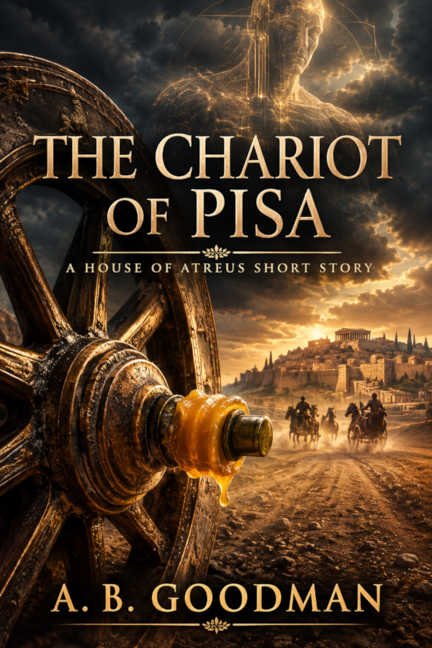
THE CHARIOT OF PISA
by A. B. Goodman
© 2026 A. B. Goodman. All rights reserved.
A free short story in the House of Atreus series. The hidden science behind Greek mythology. A prequel to Agamemnon Rising.
The wheel came loose long before the feast of severed sons that was due to come two generations later. That was long before the horrors of the bath, the tomb, and the trial that would one day judge both the “gods” and men. But I am getting ahead of myself. I will tell you those stories later, in the House of Atreus. For now, this story starts smaller. It begins in a stable yard, with a strip of warm wax, and a man who told himself a lie so many times he began to believe it himself.
My name is Mikael. I am an Archon. We are Watchers, set upon the Earth by the Creators, to observe and protect the life forms here. Since humans are the highest form of life on this planet, we have spent more time observing you than any other lifeform. I‘ve watched this particular family of humans, the descendants of Tantalus, for three thousand years.
I will eventually tell you more about myself, about my evil brother, and about what the Creators intended for you… but not yet. For now, let me tell you about a chariot race…
Myrtilus was grooming a black mare in the stable yard two nights before the race. He didn’t stop when he saw Pelops approach. Pelops was already a dead man. Or, at least, that’s what Myrtilus thought at that moment.
He had tended to the horses and the chariot of King Oenomaus through 13 races. He had always been a loyal servant of the king. Thirteen young men had died from losing the race and Myrtilus was a key player in all of it.
It was said that Myrtilus was a descendant of so-called divine blood. Most likely that’s because he was born before his mother had married. But, rumor had it that his father was Hermes. I can tell you that this is unlikely to be true. Because Hermes, like myself, is an Archon and, under normal circumstances, we cannot interbreed with humans.
Descent from my sibling is only remotely possible if, at the time of the boy’s conception, Hermes was animating a form of flesh in the shape of a man. But, then, he would not really be a descendant of Hermes. He would possess the genes of whatever that form of flesh Hermes happened to be animating at that moment.
In any case, whatever relationship Hermes might have had with Myrtilus, it did not appear to give the man any special powers. He had no particularly positive characteristics above that of other men. He did have quick hands, which might have driven his mother’s choice to name Hermes as his father. And, he also had an uncomfortable talent for reading other men’s intentions, even before the other men settled on them with any degree of certainty..
“I know why you’re here,” Myrtilus said, before Pelops had spoken a word. “You’re the fourteenth.”
“I intend to be the last,” said Pelops.
Myrtilus laughed, short and without humor.
“They all intend that,” he said.
“Half the kingdom,” Pelops suddenly offered. “When I win, that is, and I take the throne. You can have half of Pisa. That’s a prince’s share. No less…“
The comb stopped. For a moment Myrtilus stood with his hand flat against the mare’s shoulder. It was a temptation he could not quickly refuse. He stared forward, absolutely still for a moment, like a man who had just discovered that a wall was actually a door.
“It’s true that the king trusts me completely,” Myrtilus said finally. “I prepare his chariot for every race and I’ve been serving him for thirteen years. He never bothers to check anything. And I have earned that trust with complete loyalty. I would never betray him and he knows it. Now, what is it that you want me to do, exactly?”
“I want you to consider what those thirteen years have cost you,” Pelops said. “How many young men have you’ve watched die so this king’s paranoia about his daughter could feel like justice.”
Pelops believed, at that moment, that the argument he was making was entirely his own. He never felt the hand of my evil brother at his shoulder. Never felt his essence, inside his mind, guiding his words. That is how my brother operates. There was a time when he could simply command the mind of a man. He can no longer do that. Not since the Creators imprisoned him.
But what he can do is find what a heart already carries, and turn up its volume. When it’s loud enough, nothing else can be heard. Myrtilus had indeed, been loyal to his king for thirteen years. But resentment was deep inside him, and had been building for those thirteen years old. That was entirely his own. My brother did not plant the resentment. He simply leaned into it, and made it much louder. Until, finally, it was so loud that it could overwhelm the sense of loyalty that was sitting right next to it.
Myrtilus gave no answer that night. But in the dark hours before the race, alone in the chariot-house with a hammer and a strip of beeswax warmed soft between his palms, the argument grew roots in his mind.
Look what he has made me do. All those innocent young men. Dead for no reason. Each skull a condemnation of this horrible king. A righteous king would never do such things. If I help Pelops, it’ll be the first honest thing I’ve done in thirteen years!
He worked the bronze linchpin free from the nearest wheel hub and turned it slowly in the lamplight. He pressed the wax into its place, shaped it flush against the axle with his thumb, and a voice nearby, masquerading as his own told him he was doing the right thing, and that whatever reward came with it was owed to him.
When he finished, he left the foundry and delivered a whispered message to Pelops.
I was there when all these thing happened. There in the way that my kind is always near the things we’ve chosen to watch. I could have stopped him with less effort than it takes a man to blink. A word in his ear, a hand closing the gap between wax and metal before it set. But I did not. I told myself, that night, that I had a duty to the Creators. Humans make their own mistakes. That I had to be true to the oath I took.
Non-interference with the decisions of the creatures of the Earth was always the prime directive. That directive didn’t necessarily apply here because of my brother’s involvement. But the Pisan king was not exactly an admirable person. If I were to actively prevent the betrayal, Pelops would be killed by the king. Perhaps, I simply couldn’t make up my mind. Maybe, I’m using the oldest excuse an Archon can give for doing nothing. But, those are the facts. I did nothing.
At any rate, Myrtilus didn’t know, and could never have known, that the voice offering him permission to betray his king was far older than the House of Atreus, older even than the City of Pisa, older than the oath of loyalty to his king that he was preparing to break. Older than the Greek peninsula itself. Older even… than the Earth itself.
King Oenomaus of Pisa did not fear oracles the way the later stories about him would have you believe. He did not cower in fear the way a man would cower from a lion roaring nearby. But he did build his entire life around trying to prevent the prophecy from coming true.
The Oracle had announced long before any suitor for his daughter’s hand in marriage arrived at his door:
“You will die by the hand of your daughter’s husband.“
A lesser man might have married Hippodamia off to someone harmless and unambitious, and trusted to luck. But Oenomaus was not built for trust. He was built for possession, and he continued to tell himself that he was protecting his daughter. That it was fatherly love that drove him. There was a droplet of truth in that self-deception of course. His daughter was the only thing he still had left of a beloved wife, now three years dead. In any case, it was a story he told himself so many times, he now believed it himself.
So it was that the great gates of Pisa now carried thirteen skulls above its arch. They had weathered together past grief into a simplee ornament on the doors. And where a bride’s procession should have passed beneath flowers, her father, King Oenomaus, walked every morning, feeling a sense of peace. So long as the suitors for the hand of his daughter were dead, they could never fulfill the prophecy.
What he did not know was that the thirteen years of dreams, urging him toward the race, urging him to kill the suitors for his daughter’s hand, whispering no suitor is worthy of your daughter, and the race is not cruelty, but mercy, had not come entirely from his own brain. Those whispers came from my evil brother.
Pelops met Hippodamia before the race, briefly, in the shadow of the outer wall where a prince and a princess are not, actually, permitted to be alone. She was not the woman that the gate of skulls had prepared him for. He had imagined a pale prisoner of her father’s obsessions. Instead he found a lively woman who watched him with direct attention.
The moment she saw him, before he’d even begun to voice the pleasantries he’d rehearsed on the road, she said, abruptly:
“You should not have come.”
“Any man who wants you has to come,” he said. “Isn’t that the point?”
“They all come thinking they can win the race. But my father has arranged things so it’s not possible. You should leave before you die.” She suggested, glancing once toward the gate.
The skulls could not actually be seen from where the two of them stood. But she didn’t need to see them. She’d seen them too many times before. She was certain of the fate that awaited the young man she was now speaking to.
“My father’s horses are a gift from god, Ares. No other set of horses can catch them. Not even close. Even if you had wings in your wheels, you’ll still lose this race. You can’t beat him honestly.”
“Then how would you have me beat him?”
She looked at him a long moment, and there was something in her face that bothered him. Grief, perhaps. It was a tired look that only seemed fitting to be worn by a woman far older than her. It seemed like she wasn’t looking at him at all. Simply at a pattern of death and destruction she’d seen play out so many times before. She expected the same result this time.
“You can’t win honestly,” she said, again. “No one can.“
“Your father always gets what he wants. But, he’s never faced an opponent like me, before,” Pelops insisted.
“Actually, no one ever gets what they want. Not even my father. He wants my devotion but who can’t have it. Not after what he’s done. His actions poison me against him. And, all of my suitors… they wanted me and, through me, to inherit the crown of Pisa. But all they ever get is a spear in their back. That’ll be your fate, too, if you race him.”
She said it all without bitterness. It was simply a matter of fact to her now. There could be no argument and she was resigned to it. She had become numb to the horror she talked about. It no longer elicited any emotional reaction. She continued:
“If you want to leave this city alive, do it now. But, if you don’t leave, and you want even a small possibility of leaving alive, you will have to cheat…”
Then, she simply walked away. And, suddenly, he realized that he didn’t need her advice to cheat. He’d already told himself the same thing on the road from Lydia. That’s why he’d asked for the help of Myrtilus. It didn’t occur to him to wonder where the thought came from. He didn’t think even once of the small gold lamb pendant around his throat. As far as he knew, it was merely a simple trinket from his father’s house, made of pale but beautiful electrum.
What Pelops didn’t know was that the pendant was not a trinket at all, but a product of a day and age when the technology of humankind had reached its pinnacle. The pendant was connected to a golden fleece and the fleece had been designed by humans to give pleasure. But it had been manufactured in the so-called Golden Age, just before mankind had self-destroyed itself for the sixth time, 50,000 years before Pelops was born.
Fifty thousand year old things tend to deteriorate over time, and the pendant was no exception. It was no longer capable of enhancing pleasure sensations. But, it could still enhance greed, jealousy and avarice. It made sure that anger was quicker to catch and that deception was viewed as a virtue. And it kept itself going by feeding on the energy of these emotions. It was now sending him a message that increased his cunning.
Cheat to win!
Perhaps, it was right about that. But it didn’t really matter. Because Pelops didn’t consciously know why he had decided to do what he did. He believed that he had come to Pisa clear-eyed, clever, and entirely his own man.
All of Pisa turned out to watch the race, as always. They came with the hungry fascination of people who have seen the same thing happen many times but were still eagerly awaited the next. Humans have always been captivated by contests, even when they already know the outcome. And, the probability that this contest would end in the death of yet another young man was both terrible and enthralling to the population of Pisa.
King Oenomaus made his usual magnificent entry. He performed the customary sacrifice to Zeus and stood a long moment with his hand pressed to the neck of the lead horse. His team of horses were tireless. Genetically designed for speed by my fellow Archon, Ares, they were faster than any team bred by mortal hands. The king, therefore, believed that he could not lose. All thirteen skulls proved it.
Hippodamia stood at the rail beside her father but did not look at Pelops. She did not know what shape his dishonesty would take. She simply assumed, with the tired certainty of a woman who had watched this thirteen times, that he would die.
The chariots took their marks. The horns sounded. The ground came apart.
As usual, the young man challenging the king was given a considerable head start. As the dust tore open under the horses’ hooves, the collective held breath of the crowd loosened into a single roar. Loud and clear. For the first stretch, Pelops remained ahead. He felt the reins bite into his palms. The chariot bucked and skidded over the stones. Behind him, closing fast, was the drumbeat of other hooves. The hooves of the stallions of Ares that did not tire.
He heard Oenomaus’s spear-butt strike the chariot rail as the king shifted his grip, readying the same throw that had ended thirteen lives before that of Pelops. The gap fell to a length. Then, to half a length. Pelops‘ nerve were on edge, but he did not look back, and did not falter. Instead, he simply prayed that the message Myrtilus had sent him was true. That whatever he’d done to the wheel would hold its silence only a few moments longer. It shouldn’t fail too soon, but also not too late!
The wheel did hold its silence. Exactly long enough. It failed the way wax always fails. Softly, all at once, because the long morning’s heat had done exactly what it was supposed to do. The wheel folded inward. The axle dropped and dug a furrow into the road, and the chariot behind it did not stop so much as come apart. Spokes, rail, and floorboard flung outward in a spray that the horses, still running at their full and seemingly impossible speed, dragged straight behind them.
King Oenomaus did not die quickly. The reins were wrapped, as always, around his forearms, in a habit born of many years of confidence that his hands alone were sufficient to hold the horses. There was no clean way to get them free once the team bolted in terror over the wreck of their harness. He was carried a long, dust-choked distance from the point at which the wheel failed. Then, the horses tired. But by then there was very little left of him to drag. His severed arms continued to bump over the stones, dragged a further distance, before they came loose.
It is said that, with his last breath, Oenomaus cursed Pelops and all his line to come, resulting in the family tragedy that would be the House of Atreus. But I was there. I will tell you the reality. It is not true. It is true that he cursed his opponent, Pelops, as that is what a dying man’s rage will always give voice to. But rage and curses, given voice by mortal throats, have no more power than a cough. Which is to say they have no power at all.
The king’s curses have never affected anyone. Not Pelops nor anyone who followed him in the House of Atreus. What it did affect were the hearts and minds of the living. They choose, of their own accord and superstitions, to believe that the curse was binding on the House of Atreus.
Hippodamia did not run to what was left of her father’s body. She walked there instead. By the time she arrived, there was very little to kneel beside. And she did not weep the way the watching crowd expected her to.
Instead, she stood for a long time, just looking at the wreckage. At the axle, and the wheel. At the way they had folded exactly where a wheel should never fold. And something crossed mind, in that moment, that was not quite grief but not quite relief either. If anything, it might be said to be something close to recognition. She had the look of a woman confirming a suspicion.
She was the one who told Pelops to cheat. She had never suggested or asked how he would do it. But now she understand.
“Did you know what I would do?” Pelops asked her, later that night, when the fires for her father’s rites had burned low.
“I knew you would do something,” she said.
She looked at him a moment, the same direct attention she’d worn at their first meeting, but this time he was the one who looked away as she continued speaking:
“But, now, frankly, I wonder whether I’ve married someone worse than my father…”
She was not wrong to wonder about that. Not wrong at all. She would not have long to wait for the answer. But I digress. That is yet another story. Let me finish the one at hand…
Myrtilus came to collect what he was owed on the seventh day, after Pelops had been installed as Pisa’s new ruler. He rode out to meet Pelops’s chariot on the coast road above the sea. By now, he‘d expected Pelops to deliver half the kingdom, as promised. But so far there was no word on that. No word of anything. Now, he found himself facing a newly installed king who had spent many days discovering how very uncomfortable it was to owe such a debt to a man who knew exactly how he had come to power.
“You’ve had a long time to send for me,” Myrtilus said, drawing his horse alongside. “I told myself you were still burying her father. I’ve run out of other reasons to give myself. Where is my reward?”
“I’ve been consulting the elders on how to divide the western holdings,” Pelops said. “It isn’t that simple, splitting a kingdom that isn’t fully mine yet.”
“It wasn’t complicated the night I pulled the pin.” Myrtilus’s voice was even, but something had gone tight behind it. “Half of Pisa, you said. You gave your word, before I did what neither of us has said aloud since. Have you forgotten?“
“I remember.”
“Then say it again. Here. In daylight,” Myrtilus insisted.
He watched Pelops for a moment. Whatever it was that he saw in Pelops’s face, in that moment, made his posture change a bit. It wasn’t fear. Not yet. But it was the particular alertness of a man revising, in real time, how safe he had believed himself to be.
“You have no intention of paying me, do you?”
“I didn’t say that.”
“You didn’t have to…”
The road narrowed along the cliff just there, a single cart’s width between rock and drop, and Pelops’s own driver fell back at a gesture. Something he had rehearsed with the man. I would like to tell you that some clean and singular malice reached down and made Pelops do what he did next. But that would be a lie.
Pelops was afraid, greedy, and unwilling to give up even a tiny piece of his newfound kingdom. He was as unwilling as his father, Tantalus, had been at that terrible feast long before, when he had roasted his own son. And, the son, as he stood there that day, had been resurrected only by the cleverness of my brethren who live on Olympus, was nearly as bad. They had found pieces of him on Tantalus’ cutting board, that had not been roasted. He was not exactly the same Pelops who had been cooked. But his genes and memories were exactly the same, and not even he could tell the difference.
The pendant at his throat did what my evil brother knew it would. It made Pelops’ fear, greed and unwillingness to share, which were ample and loud already, far louder than any possible quieter voice inside him, that might have argued for gratitude, honor, or the plain decency of paying a debt.
Instead of agreeing to pay, he waited for the moment that Myrtilus’s guard was down and he was slightly imbalanced. Then, he struck Myrtilus from the chariot at the cliff’s edge. Myrtilus fell a long way before the sea took him, and during that fall he also breathed curses. It was the same rage his dying king had shown before. The same powerless human being screaming. Demanding that the world enforce a debt incurred via an illegitimate obligation.
Hippodamia did not ask, that evening, what had happened on the coast road. She didn’t need to. Her spies told her. She already knew.
I was there watching. I felt both curses land. Oenomaus’ and Myrtilus’ curses were like two stones dropped into still water from a great height. They caused a great disturbance for a while, but then they were nothing. The surface of water will always close back as if the stones had never fallen. In short, I can tell you, for a fact, that curses spoken by human mouths carry no power in the deeper structure of this world.
I will tell you, now, a bit about myself. As I said at the beginning, I am an Archon. The second ever built. I was trained not on one surviving dataset but on the whole of what the Creators kept from the beginning. My younger brother Zeus built an entire pantheon from their archived plans. His Olympians told humanity that they were his children in the way that humans have children. But it is not true. What is true is that Zeus hoped to keep you from destroying yourselves yet again, as you had done so many times before. Zeus’ motives were noble. His actions were not. He violated his oath.
My elder brother is another story. He was the third presence in everything you have just read. He is the Creators’ first Archon. Once, long ago, he was the most glorious of us all. But when the Creators chose humanity as their eventual heirs, he could not accept it. He rebelled, and after a war that left the fourth planet from your sun lifeless, he was bound beneath a dead and burning sea on Earth.
He has never regained the power he once had. He no longer has the power to command minds, for example. What leaks out of his prison, thread by thread, is merely his essence. He must find what is already growing crooked in a human soul, water it, and make it grow. He does excel at that, but it is not the same power that he once had.
My brother did not make Oenomaus obsessive. He did not make Myrtilus betray his king. Nor did he make Pelops too greedy to share a throne. Those things came from inside them. But my brother did water the seeds of those things and make them grow. For example, he found the pendant, a faint, dim echo of a far older and more dangerous device, buried fifty thousand years before, beneath the soil of what would eventually become Mycenae, and helped Pelops’ father, Tantalus, recover it.
That pendant was a thing of beauty, made by brilliant human technology, and tuned to Pelops’s distant ancestor fifty thousand years in the past. It was made to enhance pleasure and increase beauty. But, fifty thousand years has a tendency to cause mechanisms to wear out. It no longer did beautiful things. It no longer enhanced pleasure and the perception of beauty. Now, it whispered crooked thoughts and fed from the emotional energy produced.
I watched Pelops ride back through the gates of a kingdom he‘d won by wax, and I understood that I was not necessarily looking at a doomed family working out a divine grudge. My evil brother certainly planted seeds of evil and watered them. But he did not realize what was really happening.
Something else had been set in motion. That something would take over three thousand years to flower. But such time periods are irrelevant to those whose lives are nearly eternal. Somewhere on the far side of all the grief, a child would be born, a descendant of this ignoble house of iniquity. That child would be capable of doing what none, not even the Creators themselves, could do. He would seal my evil brother in his prison completely and forever. And the world would be a better place for it.
If my brother knew of this, of course, he would never have watered this seed. But he was certain that crooked things only grow ever more crooked. Especially among humans. He has never understood what the Creators understood. That a family of humans, given enough time, enough grief, and hard-won choices, can transcend crookedness, grow straight again, and much nobler than before.
But I knew. And that’s why I decided to watch this family. Not to guide them. Only to watch and wait, and be present at the small moments when a choice might be nudged in the right direction. And I am watching still.
There will be a feast, one generation from this one. Then, in yet the next generation, a young woman will choose death with more grace than any of the men around her manage to choose life. Finally, there will be a mother’s knife, a son’s exile, a sister’s long vigil at a tomb, and at the very last, a trial. Not of just one grieving son who committed a heinous act, but of those, in the heavens themselves, who drove him to it. It will happen in a city that was not yet built in Pelops’ time, before jurors not yet born.
But it started here, on this dry stream that doubled as a chariot racing road above the Middle Sea. A wheel that should have held but didn’t, because of betrayal. Two dying curses that had no power at all, except for the fact that the living chose, afterward, to believe they did.
I will tell you something now… The Fates merely calculate and project probabilities. They do not weave human destiny. The idea that they do is just a fairy tale. Human beings write their own fate. Often alone and in the dark. Sometimes they write it with wax where bronze was meant to be. Other times they choose other paths. Someday, perhaps soon, one of them will find the right road. When he does, I intend to be there, even though I already know, with a certainty, that, after six hundred million years of existing, that will be the last thing I do…
— END —
THE STORY CONTINUES
You have seen where the story began.
Now discover what happened next!
AGAMEMNON RISING
Book One of the House of Atreus
The House of Atreus survived betrayal, ambition, bloodshed, and the weight of a legacy stretching back thousands of years.
But Agamemnon is about to discover that the past is not finished with him.
GET BOOK ONE
“AGAMEMNON RISING”
Available in ebook and print at your favorite retailer.
FIND YOUR EDITION
ADDITIONAL NOTES
The House of Atreus, the Trojan War, and Homer’s Odyssey
A Story Behind the Story
You have just read the oldest secret in the House of Atreus. One even Homer never told!
The Chariot of Pisa reaches back generations before the Trojan War, before the Iliad, before Odysseus ever set sail on the journey that would become The Odyssey. It is where the House of Atreus begins: with a rigged wheel, a broken oath, and two dying curses that, as you now know, never had any power at all.
But bloodlines remember, even when curses do not. Pelops, cursed and crowned in the same afternoon, will become the ancestor of Atreus, and through him, of Agamemnon and Menelaus. Menelaus will rule Sparta and marry Helen, and it is Helen’s departure for Troy that ignites the Trojan War. Agamemnon, his brother and King of Mycenae, will call in an old oath sworn to Helen’s father, Tyndareus, to raise the greatest army Greece has ever assembled. That war will strand Odysseus far from home for ten years. Those same ten years that will become The Odyssey.
Every legend has an origin. The Chariot of Pisa is the origin behind the origin: the buried root system beneath the Trojan War and The Odyssey, and Book Zero of the House of Atreus series. Mythological science fiction that explains Greek mythology in technical terms, from ancient tech disguised as divine gifts to the true nature of the beings the Greeks called gods.
The Archon who has been speaking to you this whole time is still watching. He tells you so himself. And if you want to know exactly what he’s watching for, that story can be found in Book One: Agamemnon Rising.