A Fate Far Sweeter — Free Preview
SCROLL DOWN TO READ
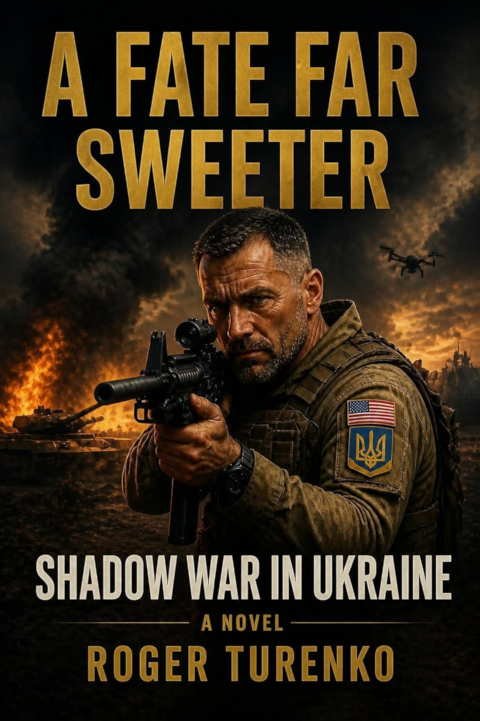
A Fate Far Sweeter is a powerful military thriller that gives readers an inside look at the war in Ukraine.
Roger Turenko’s gripping story of courage, sacrifice, love, and survival takes readers deep into occupied Crimea, where an American soldier joins Ukrainian resistance fighters on a perilous mission behind enemy lines.
It is a moving war story about ordinary people caught in extraordinary circumstances. And the choices they must make when the stakes could not be higher.
“Original, compelling, intense, and a fascinating read from start to finish. I started the book one night, and got hooked. I couldn’t stop reading until I had finished it… A memorable work of fiction that could be tomorrow’s reality…”
— James A. Cox, Editor-in-Chief, Midwest Book Review & Library Bookwatch
Chapter 1: Attack of the Drones
“When a man is slain, words cannot resurrect the dead. But, for the sake of life, Must we bow and obey? The dictates of a tyrant? For death is a fate far sweeter than tyranny.” Source: Aeschylus’ Oresteia (458 BC), Agamemnon
Ukraine-On The Black Sea Coast
The first thing they don’t tell you about war is how it smells. Cordite, diesel fuel, and fear-sweat create a cocktail that burns your nostrils and brands your memory. The second thing? How quickly you learn to love that stink, because it means you’re still alive to smell it.
I would smell that stink in the air that day. But before it came, thick fog enveloped the southern Ukrainian shore, making everything moist and slippery. Relentless rain fell from the heavens with no sign of stopping. Typical for this region in springtime, they tell me. It was deep into the night, hours before dawn, and darkness prevailed. Even the moon was obscured by gloomy clouds. For a while, there was an eerie quietness.
Then the shrill scream of air raid sirens ripped through the atmosphere.
“Take cover!” a soldier nearby bellowed.
As I sprinted toward the bunker, muscle memory from twenty years of military service taking over, one thought cut through the chaos: What the hell am I really doing here? Fourteen months ago, I was Colonel John Kovalenko, retired U.S. Special Forces, living quietly in suburban Virginia. When President Zelensky’s call for volunteers reached me in March 2022, I’d planned to come as a trainer—help prepare Ukrainian forces with my expertise, then return home to my comfortable retirement.
My Ukrainian grandparents would have been proud. They’d fled this land at the turn of the century, but they’d raised me to remember where I came from, to understand that the blood of this soil runs in my veins.
But training recruits behind the lines hadn’t been enough. Not after what I’d seen in that field hospital outside Kharkiv. A young medic, barely nineteen, dying from shrapnel wounds while still trying to tend to others.
“Tell them we existed,” She’d whispered in accented English when she learned I was American, “Tell them we fought.”
That’s when I’d stopped being a trainer and started being a fighter.
I ran with a contingent of Ukrainian soldiers stationed on night duty toward the entrance of one among many fortified subterranean bunkers, meticulously constructed for moments like these. Most of us sought refuge. But a small group of brave electronic warfare specialists ventured forth, knowingly exposing themselves to the perils of shrapnel from the oncoming rain of bombs and missiles. They did this to defend the base.
These specialists were always our second line of defense, the first being automated. They were armed not with normal rifles, bazookas, or any other projectile launching equipment, but with futuristic electronic gun-like contraptions that looked very much like props from a “B” rated science fiction movie. Such rifles carried no bullets, but they were among the most powerful anti-drone weapons we had. They sent out electromagnetic signals capable of jamming, immobilizing, or taking actual control of unmanned aerial drones.
The air was already filled with the earthshaking explosions of drones being brought down by our first line of defense. The noise was deafening, making it hard to think, let alone talk. But in the chaos, I knew one thing for certain: this was war, and in war, survival is everything.
There was a young Ukrainian officer standing just outside the entrance of my bunker, shouting into his radio in Ukrainian. He was trying desperately to overcome the deafening noise, anxious but determined. His voice cracked with the strain.
“Alpha Squad, hold your ground!” he yelled. “Don’t let the bastards through! Choppers on the way. They’ll be here in a minute or two… meanwhile, defend the base! Bring down any damn drones that get through!”
In that moment, listening to this kid trying to hold together a defense against overwhelming odds, I understood why I’d made the transition from trainer to frontline fighter. It wasn’t just about my Ukrainian heritage or honoring my grandparents’ memory—though those mattered. It wasn’t even about the dying medic’s words, though they haunted me.
It was about these young people, who should have been able to start their lives. Instead, here they were, along with older men and even some women, learning to coordinate life-and-death decisions, while Russian drones tried to grind them into hamburger meat. After Kharkiv, after Bakhmut, after seeing what these people were capable of when their backs were against the wall, how could I have stayed safely, behind the lines, teaching weapons maintenance?
His radio crackled with an answering voice.
“I got one, I got one!” the voice cheered in Ukrainian. “Another! Two direct hits! But there’s too many of them! I’ve never seen so many at one time!”
“Good job!” the officer said. “Keep at it! Use the tracking systems. They’re online. Don’t panic. We have to stay focused, stay sharp. Bring them down!”
Another voice cut in, loudly: “Incoming! Take cover!”
A deafening blast shook the ground. One of the Russian kamikaze drones had hit the sand near the Ukrainian soldiers who were busy firing their anti-drone weapons. Sometimes that happened, even if the drone’s targeting system had been successfully disabled, if the specialist couldn’t induce the drone to explode itself in mid-air.
“Wolfman!” the officer called out the soldier’s code name, worried. “Wolfman! Talk to me! Talk to me!”
There was no answer, and the officer seemed desperate, forgetting for the moment that he was supposed to use only the man’s code name.
“Are you hit? Are you okay? Sergey!…”
“Sergey!”
The lieutenant’s slip from code name to real name hit me like a physical blow. In that single word, I heard every squad leader I’d ever known, every friend I’d lost, every time the radio went quiet when you desperately needed it to crackle back to life.
Part of me… the rational, survival-focused part that had kept me alive through two decades of Special Forces operations, whispered that I’d already done enough. I’d helped train thousands of Ukrainian soldiers, I’d fought in Kharkiv when we pushed the Russians back, held the line at Bakhmut when everyone said it was hopeless. I could return to training duties, or even back to complete safety inside America, with my honor intact even after the plea from that medic.
But then, there was that other part of me, the part that carried my grandparents’ genes. The same genes that energized these people bravely defending their country. And, stories from my grandparents, that told of fleeing this land a century ago at the points of Russian Communist rifles. The other part knew better. Evil doesn’t recognize borders. Tyranny doesn’t check your family tree before it kicks down your door.
He wasn’t a soldier serving under my command. I didn’t even know the young man. But, I was relieved to hear the voice of the same soldier come back onto the radio, and say, in Ukrainian.
“I’m OK, lieutenant, I’m OK,” the voice said, “That was close. I’m setting up again. Not done yet. Got plenty more of those bastards to take down! Don’t worry!”
The men and women of the Ukrainian armed forces are mostly volunteers, but many have also been drafted. They come from widely different backgrounds, regions, and professions. Some are very young. A lot are older than anyone who’d be accepted into the American army. Yet all share a common bond. They love their country as much as I love mine. They want it free from Russian tyranny. Ukraine is anything but a perfect democracy. It still struggles with the legacy of Soviet corruption and mismanagement.
But every soldier in the Ukrainian armed forces, and every civilian, knows how they want it to change. They want Ukraine to join the community of Western democracies. They want it to prosper. They want a better life for their children, and for their children’s children. They want nothing to do with the old-style Soviet universe or the new-style Russian fascism that has been embraced by their neighbor.
The Russians could bomb the place, terrorize it, kill people, and destroy things. They are very good at that. But they could never break the spirit of the defenders. Nor could they penetrate this particular base with anything they could deploy, save nuclear weapons. The base was well fortified with steel-reinforced concrete lined caves, which sheltered all the critical equipment and supplies. That made it virtually impossible to destroy the Ukrainian sea drone fleet, which was mostly safely hidden deep within the reinforced caverns.
Those small Ukrainian “Sea Babies,” “Kozak mamais,” Magura V5s, and other unmanned watercraft are small but powerful kamikazes. They can strike anywhere in the Black Sea. They are the bane of the Russian Navy, lurking in dark waters, waiting for the right moment to strike. When they strike, they inflict serious damage on ships both in port and on the sea. The Russians tried many times to destroy this base. Each time they failed. They were trying again with everything they had. But the Ukrainians were ready for them. They always were.
There was a rumbling noise, an increasingly loud hum, almost like that of a huge number of mopeds converging together on one destination. It echoed the approach of the surviving Shahed drones. These had made it through our first line of defense, the automated weaponry, as well as our second line, the electromagnetic radiation guns. So, now the night sky erupted in another mesmerizing spectacle, as manned anti-aircraft guns unleashed a barrage of tracer rounds, illuminating the darkness, turning it into a canvas of flickering lights. The relentless dance of destruction continued, punctuated by thunderous explosions, as drone after drone met its demise.
Our defenses were slowly but valiantly conquering the drone onslaught, but a darker truth loomed. Cruise and ballistic missiles were always an imminent threat in every attack by swarms of drones. Cunning Russian strategists employed the cheap drones mostly as a diversion, hoping to overwhelm our anti-missile defenses. Knowing that our critical facilities were built of reinforced concrete, their ultimate goal was to get heavy missiles through the defense grid. They had learned this technique from us. Meanwhile, one drone and missile after another succumbed to our kinetic defenses. They were pulverized in the air. Reduced to ashes.
Then, suddenly, the earth seemed to shatter under our feet. The ground quivered as if an ancient beast had been awakened and was clawing its way out from under the earth. Dirt and rocks cascaded down from the precipice. A heavy Russian missile had evaded all of our defense systems. It had struck the high ground, shattering the newfound sense of invulnerability that had arisen from the mostly successful operation of our defenses.
That one’s going to leave a big hole, I thought.
The taste of concrete dust filled my mouth, gritty and bitter. My ears rang from the concussion blast, and for a moment I was back in Afghanistan, watching a Humvee disappear in a cloud of smoke and debris. The same helpless rage, the same desperate prayer that somehow, impossibly, everyone had made it out alive.
The Russian leadership has no decency. If it had, it would not have invaded Ukraine, a country whose only “offense” was aspiring to join the community of free, prosperous nations. There is little doubt that they would deploy nuclear weapons if they could. But, they cannot use such weapons in Ukraine despite their intentionally frightening rhetoric and apparent willingness to do so.
This reluctance has two key sources. First, Russia’s strategic goal is to transform Ukrainians into obedient, hard-working laborers. That objective that would be impossible if the population were devastated by radioactive contamination. But, the primary deterrent is environmental. The Earth’s west-to-east rotation, combined with Europe’s trade winds and the Gulf Stream, creates weather patterns that work harshly against Russian interests. More warm air flows northward from the equator than cold air flows southward, even in winter, resulting in prevailing winds that blow from southwest to northeast across the region.
Ukraine is southwest of the most populated regions of western Russia. If they went nuclear, the radioactive fallout would heavily contaminate Russia’s farmlands and cities, including the place that the leadership calls home—Moscow. As a result, they restrict themselves to the use of conventional warheads. But by May 2023, they were running low on precision conventional weapons. They were beginning to use whatever they could find, including relics of the Cold War, like intermediate-range ballistic missiles rearmed with conventional warheads. The big hit on the escarpment had to be one of those. A long range ballistic missile armed with a heavy conventional warhead.
But, it doesn’t have to be a nuke to make you lose your hearing. The explosion of a large conventional warhead makes enough noise to wake the dead. And, the sound of the Ukrainian choppers cut the air and the pace of the smaller explosions grew faster. The helicopters were shooting air-to-air cannons at the Russian drones. Shahed drones are susceptible to this, and the chopper gunmen know their job. The intensity of the Russian attack began to go down quickly. Most drones were destroyed. Then it was all over. Only one kamikaze drone and one missile had gotten through the gauntlet.
The full extent of the damage wouldn’t be clear until morning, but I doubted it would be severe. There would be a huge crater on the high escarpment, but the area was empty land anyway. As for the drone that had hit the beach, the ebb and flow of water would bring in new sand and even out the old. The crater would fill itself in a matter of days.
Such ordeals are nerve-wracking to those new to war. But war is not new to me. And I like to look at the silver lining inside every dark cloud. I could hardly keep my eyes open before the attack, but now the adrenaline rush had made me hyper-alert. No coffee needed. And, I needed that, at the time, because I was due to embark on my mission, so it saved me from resorting to caffeine.
A new siren emerged from the speakers, giving us the comforting “all clear” signal. Everyone not directly engaged in defending the base began emerging from the bunkers, including me. I took a deep breath. The air was foul because of the lingering stink of scorched explosives. The drizzling rain, which had been unwelcome before, was gone. It would have been welcome now because it might have washed away some of the stink. It would stay stinky for a while.
As the all-clear siren wailed across the base, I emerged from the bunker feeling something I hadn’t experienced in years. Purpose. A reason for being. The acrid smoke burning my lungs, the adrenaline still coursing through my veins, the knowledge that I’d just survived another night in hell… Yet, somehow, it all felt right. I know that doesn’t make much sense, but somehow it did make sense, at least in that moment, for me, back then.
The cool damp breeze was still blowing, tingling my scalp under closely cropped hair. I glanced around and up at the sky. You still couldn’t see any stars or moonlight through the thick layer of clouds. Everything was very dark again. It was hard to see. But, to the extent that I could see anything, it seemed like everything was back to exactly the way it was before the Russian attack.
The makeshift marina was seemingly unscathed. As far as the darkness would show, all the little boats remained securely fastened to the docks. That’s what I needed because soon one of those boats would take me on a journey to Crimea.
But, there was something that had changed during those minutes of chaos. Somewhere in that hell, between the screaming missiles and the crackling radio chatter, a new sense of resolve grew inside of me. In less than an hour I would board a tiny craft that would take me on a mission so dangerous that even battle-hardened Ukrainian officers would shake their heads, think me crazy, and call it suicide.
An infiltration deep into Russian-occupied Crimea.
But, after tonight, after Kharkiv, after Bakhmut, after seeing what these people were willing to sacrifice, and knowing the history of my own family, I knew for sure why I was here, in this foreign country, fighting this war. The medic’s dying words echoed in my mind:
“Tell them we existed. Tell them we fought.”
Sure, I would tell their story. But, now, I was also ready to start telling mine. And if I was very lucky—or very unlucky, depending on how you look at things—I might even live to tell it.
Chapter 2: The Road To Crimea
The Black Sea doesn’t care about your mission. It doesn’t care if you’re fighting for freedom or revenge. It’s not afraid of ghosts. And, it doesn’t give a shit about right and wrong. It just wants to kill you. Twelve hours in a jury-rigged submarine the size of a coffin will teach you that.
My name is John Kovalenko. It’s not my real name, of course. I’ve invented it for the purpose of telling this story in a confidential manner. That’s because, even in retirement from twenty years of U.S. Army service, some secrets must stay buried. But the name fits this mission, because it’s a Ukrainian name and it carries the weight of my grandparents’ blood and, maybe, even the promise I made to the dying medic.
Her words had been echoing in my cramped metal tomb since I’d left the Ukrainian coast before dawn. The mini-sub’s hull groaned, now and then, maybe with each wave, although that was impossible given that, most of the time, at least, I was underneath the waves. But, it reminded me that this contraption had been cobbled together from salvaged parts and pure Ukrainian brilliance and determination. The engineers who’d built it had done their best, but their best meant I was piloting what amounted to a torpedo that happened to have “delusions of grandeur!”
The submarine was designed to reach a maximum velocity of thirty-two knots while fully submerged. That’s about sixty kilometers per hour on paper. Or, in the terminology understandable by Americans who aren’t sea Captains, about 37 miles per hour. That’s very fast for a submarine. But, it’s the theoretical maximum. Reality, as always, proves more stubborn than theory. After twelve hours and two surface charges using diesel generators that made the cramped space reek somewhat, of fuel fumes, I was finally approaching Cape Tarkhankut. My knees pressed against my chest. Salt water was seeping through hull joints, and I was breathing recycled air that tasted like diesel and desperation.
This wasn’t how I’d imagined spending my retirement.
Three days ago, I’d been in Kyiv, standing before General Rutanov’s desk like a soldier reporting for duty. The general was an unusual military leader. A lawyer by training who’d earned his stars through competence rather than connections. He was short like President Zelensky, and many other Ukrainian men of his generation. That was the legacy of post-Soviet malnutrition. But, in spite of his modest height, he commanded respect through sheer force of will and tactical brilliance.
He’d looked up from his war maps with eyes that hadn’t seen enough sleep since the invasion began. His simple green T-shirt, which he wore in preference to a uniform fit for a general, was the same informal style favored by President Zelensky. But, contrary to what you might think from hearing that, it actually made him seem more formidable, not less.
“I need something spectacular,” he’d said without preamble, sliding a worn folder across his desk.
Inside was my own proposal from over a year ago. It was a plan to infiltrate Russian-occupied Crimea and destroy a critical missile storage facility. I’d written it during quiet moments between battles, a theoretical exercise that had seemed almost academic at the time.
“My predecessor thought you were insane,” Rutanov had continued, his English flawless despite never having left Ukraine until middle age, “Dumped it in the trash, from what I can tell… well, not literally, of course, or we wouldn’t be here, would we?”
“And you, sir?”
His smile had been sharp as a blade.
“I think you’re insane too. But I also think you’re right.”
He’d leaned back in his chair, studying me with calculating eyes.
“We need both a real and an informational victory. The counter-offensive… well, you know as well as I do how deeply the Russians are dug in. The minefields, the trenches. It’s going to be brutal, and we can’t guarantee success. But we still need to show our Western allies that we’re taking the fight to the enemy.”
I’d nodded, understanding immediately. War isn’t just about armies clashing on battlefields. Morale, propaganda, and the perception of vulnerability were all things can be as decisive as any tank or missile. In a conflict where foreign assistance played such a crucial role, demonstrating Ukraine’s capacity for bold, proactive strikes could mean the difference between continued support and war fatigue.
“The goal,” Rutanov had explained, “is to cut Russian supply lines and make them feel unsafe even in their stolen territories. We want them in panic mode, constantly looking over their shoulders. A thousand little cuts instead of one big blow. That’ll save my men’s lives and eventually, hopefully, break the Russians’ will to fight.”
He’d paused, his gaze drifting momentarily before snapping back to focus with renewed intensity.
“It’s your plan, of course, but your American accent could be a problem. We have Ukrainians who can speak Russian like natives, but none with your particular skill set. Scuba diving, explosives, covert operations, submarine piloting—you’re uniquely qualified for this type of assignment.”
Back inside the little submarine, as I thought back to my conversation with General Rutanov, the weight of that last qualification was pressing against my ribs, right at that very moment, as the submarine’s sonar pinged softly. Cape Tarkhankut was dead ahead. But, there was nothing I needed to do immediately, so the memories kept flowing back to me.
“I don’t have the manpower to send a squad,” the general had continued, “And I don’t think it would do it even if I had the men. Because this is a job for one very capable man with local partisan support. The partisans… they’re patriots… but they’re not professional soldiers. They’ll need your leadership. You’ll need to teach them a lot. Show them how to place explosives for maximum effect, and how to use whatever equipment you bring. That sort of thing…”
I hadn’t hesitated.
“I’m ready to go, sir. I appreciate your confidence.”
He’d stamped my orders with the official seal that made it real, then looked up with something approaching paternal concern.
“Do you have a wife? A steady girl?”
“No, sir.”
“Of course you don’t,” he’d chuckled, “Because if you did, she wouldn’t have let you come here in the first place.”
The smile had faded as he returned to his maps, mind already shifting back to the enormous weight of command.
“God speed, Colonel.”
Now, suspended in the murky waters off the Crimean coast, I understood why he’d asked about wives and girlfriends. This wasn’t the kind of mission you came back from if your heart was somewhere else. But my heart wasn’t anywhere else. It was right here, right now, in this war, with these people who’d shown me what courage really looked like.
I surfaced just enough to extend the periscope, scanning the coastline through the green-tinted lens. The cliffs of Cape Tarkhankut rose from the water like the walls of an ancient fortress, their faces scarred by centuries of wind and wave. The Tatars who’d originally inhabited this land had called it “Tarkhankut.” That literally translates into “The Devil’s Corner.” Staring at those jagged rocks through the periscope, I understood their logic.
But the forbidding landscape also meant concealment. Towering cliffs, mysterious caves, and treacherous waters made casual surveillance difficult. Russian patrols couldn’t see everything from up there, and the rocky shallows were very dangerous even for modern boats to navigate. Hazardous enough to discourage boat traffic. It was the perfect place for a covert insertion. But, of course, part of the risk you took, when you came this way, was being smashed against the rocks by the next wave.
The submarine’s electric motor hummed as I maneuvered closer to shore. According to my briefing, partisan contacts would meet me at the narrow beach after nightfall. But nightfall was still hours away, and staying submerged in this cramped space was becoming unbearable. Every muscle in my body screamed for movement, for space, for air that didn’t taste like machine oil and recycled breath.
The decision to exit early wasn’t tactical. It was entirely psychological. I just couldn’t stand it anymore. I needed to move, to stretch, to feel something other than tiny metal walls pressing in from all sides. In the Special Forces, there’s an old saying:
“Comfort is the enemy of alertness.”
But, frankly, cramped up in that coffin of a submarine, discomfort was the enemy of sanity.
Getting into my wetsuit was an exercise in contortion. The submarine was designed to transport equipment. That is, a big bad warhead that would blow up big manned Russian naval vessels. It was not designed for human transport or habitation. Every movement was a negotiation with physics and claustrophobia. But finally, I was suited up, diving gear checked, and my waterproof equipment bags were secured with nylon rope.
The mini-sub’s only exit was through a modified torpedo tube. That was a detail that had seemed almost funny during the planning phase. Now, wedging myself into the narrow cylinder with my gear trailing behind me, it felt like I was loading myself into my own funeral cannon. The space was so tight I could barely breathe, let alone move.
I activated the internal mechanism. The hatch sealed behind me with a mechanical thunk that reverberated through my bones. Then the outer door cycled open, and suddenly I was expelled into the cold embrace of the Black Sea like a bullet from a gun.
The shock of cold water was immediate, even through the wetsuit’s neoprene protection. For a moment, I hung suspended in the murky depths, watching the submarine’s dark silhouette fade into the gloom below. In spite of its drawbacks, which were many, that submarine was my lifeline back to Ukrainian-controlled waters, assuming I survived long enough to need it.
The water was murkier than I’d expected. But, that wasn’t bad. It was a good thing. Good for concealment, terrible for navigation. Eventually, muscle memory took over, and I began to swim, and the freedom was intoxicating. After twelve hours of claustrophobic confinement, being able to extend my arms and legs felt like a resurrection. I moved through the water with long, deliberate strokes, working out the kinks in my muscles while staying deep enough to avoid surface detection. A large, colorful fish glided past, oblivious to my presence, and then, it disappeared into the murky depths like a good omen.
I had two air tanks. Ninety minutes of breathing time total. But I needed to save one tank for the return journey, assuming there would be one. That left me forty-five minutes of underwater time before I’d be forced to surface, exposing myself to observation and potential detection.
When I finally broke the surface, the first thing I noticed was the silence. No air raid sirens, no explosions, no crackling radio chatter calling out grid coordinates and casualty reports. Just the rhythmic sound of waves against rock and the distant cry of seabirds. It was almost peaceful—if you ignored the fact that I was now deep in enemy territory, alone, carrying enough explosives to level a city block.
The narrow beach at the base of the cliffs was exactly as described in my briefing: a sliver of dark sand and pebbles barely wide enough for a man to stand on, squeezed between towering rock walls and the restless sea. Perfect for a clandestine meeting, terrible for everything else. The cliffs rose at nearly ninety degrees from the waterline, offering no escape route except back into the water.
As I pulled myself onto the rocky shore, water streaming from my wetsuit, I couldn’t help but think about the journey that had brought me here. Not just the tactical decisions and strategic planning, but the deeper currents that had carried me from suburban Virginia retirement to this remote corner of illegally occupied Crimea.
My Ukrainian grandparents had fled this land at the turn of the century, driven out by Russian oppression and the promise of freedom in America. They’d raised me to remember where I came from, to understand that the blood of this soil ran in my veins. Now their grandson was returning, carrying explosives, in what most normal people would call a death wish.
There was a odd symmetry about it. It almost felt almost like destiny. That is, if you believed in such things. I do. But sitting on that narrow beach as the sun began its descent toward the horizon, I could almost hear my grandfather’s voice:
“Sometimes a man has to go back to where his story began to understand how it ends.”
The partisan contact wouldn’t arrive for hours. I had time to think, to plan, to prepare mentally for what came next. But too much thinking is dangerous territory in this business. Thinking leads to doubt, and doubt leads to fear. Fear leads to hesitation, and hesitation leads to death. Better to focus on the mechanical aspects of the mission: equipment checks, route planning, contingency protocols.
The missile depot was a long way away, heavily guarded, and packed with enough ordnance to flatten half of Ukraine if the Russians ever managed to launch it all. Intelligence suggested they were stockpiling for a major missile offensive, probably targeting critical civilian infrastructure in Kyiv and other cities. Getting in would be difficult. Placing the charges without detection would be nearly impossible. Getting out alive would be a miracle. Why had I come here? Why was I about to do this?
But as I thought about these things, I methodically checked my equipment, which was a habit honed by years of experience. The explosives, detonators, drones, invisibility cloaks, communication gear, backup weapons. Everything I needed for the mission had made it here safely. I thought about the medic’s words again and focused on that, to avoid the possibility of succumbing to fear:
“Tell them we existed. Tell them we fought.”
If I could destroy that depot, if I could prove that even the heart of Russian-occupied territory wasn’t safe from Ukrainian determination, then her death would mean something. Maybe it all meant something. The young officers I’d seen blown to bits in Afghanistan, the patriotic Ukrainians who risked it all in Kharkiv and Bakhmut, the electronic warfare specialists risking shrapnel to defend their base, the countless others who’d chosen to fight rather than submit. All of it meant something.
The sun was setting now, painting the forbidding cliffs in shades of gold and crimson. The temperature was dropping, and I could feel the chill seeping through my wetsuit despite my body’s efforts to warm the trapped water. Soon, the partisan would arrive with local knowledge, equipment, and hopefully a way to get me closer to the target without walking all the way through enemy territory.
Chapter 3: The Fire in Our Eyes
The Crimean coast has a stark beauty that reminded me why my grandparents had spoken of this land with such longing, decades after their exile. These weren’t the gentle, rolling landscapes of suburban Virginia where I’d planned to spend my golden years. This was raw geography. It was stone and sea locked in an eternal battle, neither willing to yield completely to the other. It was the kind of place that forged hard people.
My grandfather’s voice echoed in my memory, words spoken in the broken English he’d never quite mastered:
“The land… it gets into your blood like iron. Makes you strong or kills you. No middle ground.”
He’d been right about that. Sitting here, surrounded by the ghosts of Tatar fishermen and Soviet political prisoners, Ukrainian patriots and Russian occupiers, I could almost imagine that iron seeping into my bones. It wasn’t just another mission. It was a homecoming.
A sudden clatter of falling stones broke my reverie. Above me, perhaps two hundred feet up the sheer face of the cliff, a figure had appeared against the darkening sky. Even in the dim light, I could make out the silhouette of a man descending with practiced ease, his headlamp cutting a narrow beam through the gathering dusk. Rappelling gear, methodical movements, no wasted motion. Either this was my contact, or I was about to have a very short conversation with Russian special forces…

FREQUENTLY ASKED QUESTIONS
Is A Fate Far Sweeter a Ukraine war thriller?
Yes. A Fate Far Sweeter is a military thriller set during the war in Ukraine, with much of the story taking place in Russian-controlled Crimea.
Where is A Fate Far Sweeter set?
The story is primarily set in Crimea, including locations such as Cape Tarkhankut and Simferopol, amid the Russian occupation of the peninsula.
What is A Fate Far Sweeter about?
The novel follows John Kovalenko, an American former soldier who joined the Ukrainian Foreign Legion and becomes involved with Crimean resistance fighters. His mission was to destroy a Russian missile storage facility leads to a dangerous prison rescue, encounters with Russian forces, and a struggle for survival behind enemy lines.
Can I read a preview of A Fate Far Sweeter for free?
Yes! This page provides a free preview of A Fate Far Sweeter. You can also download the pdf version of the preview to read later.
Clicking on affiliate links results in a small % commission being paid to the website owner, but does not change the cost of the item.